Skip to content

Home

Prince Fielder and Prospects

So there’s this hilarious MLB Network ad starring Prince Fielder, and it begins like this:

Prince: Hey it’s me, it’s time to say goodbye.
Harold Reynolds: Are you sure?
Prince: Yeah, I’m sure.
Reynolds: Okay Prince we’ll let everyone know. [hangs up]
Reynolds [to studio panel]: That was Prince Fielder, he said it’s time to say goodbye.

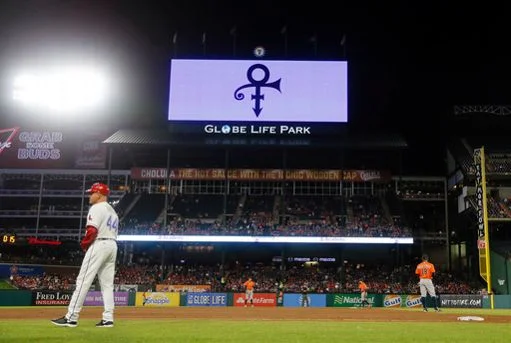
It ends with a Fielder home run, presumably from last season, that clears the shortest section of Globe Life Park by a whole three rows. Then Prince, running in place in front of a green screen — which looks totally natural by the way — waves to the audience and says “goodbye.”

It is a fool’s game to question the reality of an MLB Network spot, but it’s the reality (or lack thereof) that makes this commercial so amusing. Prince Fielder is not a good hitter anymore and, what’s worse, even if he does put up a respectable slash line in 2016, it still won’t be enough to make him much more than a replacement-level player.

In Fielder’s Comeback PoY campaign in 2015, where he slashed .305/.378/.463 (124 wRC+), he was only worth +1.6 wins according to FanGraphs. That’s how hard it can be to rack up value as a designated hitter. For context, in 2015 Prince provided roughly the same WAR as the fan base’s oft-scapegoat, Elvis Andrus (+1.6 fWAR), and Robinson Chirinos (+1.5 fWAR), who played only 78 games.

This year Fielder has been one of the worst players in baseball, slashing a putrid .187/.247/.293 (42 wRC+) with just 4 extra-base hits (2 HR) in 85 plate appearances.

Extrapolated over an entire season, his current 8.2% walk rate and 20% strikeout rate would each rank as career-worst marks.

His 25.9% hard contact rate is about 10 points lower than his career average (36.5%), and 6 points lower than his 2015 figure (32.3%), where his power noticeably declined.

Aside his unsustainably low .203 BABIP, there isn’t a lot out there to suggest he should be much better than he has been. It’s taken 20 games and Prince Fielder is already inching his way to being worth a full win below replacement. Unless something changes drastically over the next 12-18 months, the Texas Rangers are going to have a helluva time doing what they wish they had been able to do already —

To say “goodbye,” back.

* * * * * 

The Rangers are in a unique position. They are fielding a competitive major league team, yet they have better players in Triple-A who are blocked in the meantime by high-priced veterans. At some point, likely during the offseason, Texas is going to have to shed one of their major contracts to make room.

I’ve been an Elvis Andrus supporter (or apologist) for the duration, but even I’m unsure whether he’s a better player right now than former top prospect Jurickson Profar. Yeah, Elvis (.317/.348/.429 (112 wRC+) has been excellent to start the season, but once some of the noise of his .357 BABIP levels out — and it will — everyone will see he is pretty much the same hitter he has always been. And don’t get me wrong, the Rangers didn’t extend him for 8 seasons because they thought he would turn into Troy Tulowitzki at the plate.

But Profar just doesn’t have anywhere else to go, and it’s hard to imagine the Rangers sticking it out with him for this long, only to use him in a future trade or some obscure super utility role. In Round Rock, Jurickson is currently slashing .328/.394/.438 with 1 HR, 4 2B’s, and an impressive 6/9 BB/K ratio. His bat is ready for the big leagues.

Speaking of bats, Joey Gallo still exists, and his incremental progress over the last three years — namely, cutting down on his booming strikeout rate — is on track to pay massive dividends. Scott Lucas sent out this brilliant tweet last night, saying:

AAA batters with more walks than Joey Gallo: 1

AAA batters with more strikeouts than Joey Gallo: 33

It can’t be stressed enough how huge this is. Also at Round Rock, Gallo is slashing .283/.413/.717 (good for a 1.130 OPS, if you’re into that sort of thing) with 7 HRs, 1 3B, 3 2Bs and a 15/18 BB/K ratio. He, too, would be an immediate upgrade for the Rangers, but with the club stocked to the brim with corner infielders and corner outfielders, there isn’t a place to put him. For the time being, it’s probably for the best that he stays in Triple-A for another month or two.

Then there’s Nomar Mazara, who I don’t really need to write about since everyone already knows how awesome he is. Filling in for Shin-Soo Choo, he’s hitting .354/.411/.521 (160 wRC+) in his first 56 plate appearances, and hasn’t been overwhelmed even a little (6/9 BB/K ratio). Adam Morris of Lonestarball gets more in depth on the club’s options once Choo returns to the lineup in a couple weeks, but it’s getting harder to argue for sending Nomar back to the minors the more he produces.

In Fun GM Land, I would love to see all the young talent playing and helping the big league team. The reality is less fun, especially with Prince Fielder hemorrhaging outs from the middle of the order. But if the lineup continues underperforming from a few key spots, it will be interesting to see the line Jon Daniels decides on taking when he juggles his roster later on in the year.
Finding Meaning Behind the Madness

At this moment, the Texas Rangers are 10-6 and in sole possession of first place in the AL West. They’ve completed just under ten percent of their 2016 schedule, and now, as winners of 4-straight — including a sweep of the division rival Houston Astros — head to Chicago to take on the White Sox.

Texas will manage to dodge facing Chris Sale, instead drawing Jose Quintana, Carlos Rodon, and Mat Latos. Latos, the owner of a shiny 0.49 ERA after three starts, would be a guy I’d imagine is due to get roughed up a little. His strikeouts are down, his FIP and xFIP — 2.83 and 4.79, respectively — would seem to suggest that he’s had a bit of good fortune behind him. A BABIP of .118 would seem to back that up.

Meanwhile, the Houston Astros will welcome the Boston Red Sox to Minute Maid Park. The Red Sox have produced the 2nd-most runs in the American League up to this point while scoring 74 runs. The most? Your Texas Rangers, with 77.

In other words, while Texas will be on the road facing a team that struggles to score runs, dodging their ace in the process, Houston, now at 5-11 and last in the AL West, will be taking on another prolific lineup. It wouldn’t surprise me to see Houston more than 5 games back in the division by the end of the weekend.

It’s a far cry from where things stood at this time last season. At this point in 2015, Texas couldn’t seem to put together any sort of solid baseball, and they were without Yu Darvish. The Astros were the team lighting the baseball world on fire. And while things turned around by the end of the season, it can be argued that the head-to-head record between the two teams was the biggest difference in Texas finishing the 2015 season with a 2-game edge on Houston.

The biggest difference between this year and last? Heading into 2015, neither team was expected to realistically compete by many in the national media. The Astros were seen as still being a year away, and in injury-riddled 2014 had soured many on the Rangers, not to mention the prospect of Yu Darvish pitching exactly zero games for the team in 2015. Of course, we know now that the Astros arrived a year earlier than many thought. Texas managed to hang on just enough to be relevant as the season wore on. Of course, it also helped that Cole Hamels effectively picked Texas over Houston at the trade deadline.

Something else to chew on? Houston just played its first three games within the division in their 2016 season. After their series against the Red Sox, they’ll play 10 of 13 games within the division. Texas has already played 13 games within the division, winning 8 of those contests. As we head into the month of May, Houston and the rest of the AL West will be beating up on each other. Texas? How about getting some guy named Yu Darvish back being on the horizon?

So while there isn’t much to be gained from one three-game series in mid-April, there’s something to be said for taking care of business early and not needing to dig out of a hole all season long. The 2015 Rangers were able to dig out of that hole. It remains to be seen how well the 2016 Astros can do the same, or if perhaps they’ll end up buried even deeper.

This may seem obvious, but I wouldn’t expect the Rangers to hit so well against Dallas Keuchel moving forward. He was the AL Cy Young Award winner last season for a reason, and the smart money would be on him having more good outings than bad going forward. Thursday night was the exception, not the rule.

So, no, there’s probably nothing predictive or even substantial to put our collective finger on that will ever say that this past week of baseball was the difference in the division. Even with a full season of results, it’s often difficult to find meaning in the madness.

Even with the top run-scoring offense in the American League, FanGraphs apparently doesn’t think much of the Rangers, still seeing them as the worst team in the AL for the rest of the season. And if you’re inclined to believe that, go right ahead. I just can’t wrap my head around that kind of thinking.

And no, in the grand scheme of the season, a three-game sweep in April probably won’t hold much overall meaning come September… until it does. And while we’ll have to wait and see if each team continues to trend in their respective directions, it sure is nice to be on the winning side at this point of the season for a change.

The Rangers Sweep Houston, Are Now 10-6

(AP Photo/Tony Gutierrez)

(AP Photo/Tony Gutierrez)

Hey, now that’s what I call a series. The Rangers defeated the Astros 7-4 on Thursday night, the club’s 4th win in as many games, to complete their first sweep of the year. 

A.J. Griffin went 6 innings, allowing 2 runs on 4 hits, with 6 strikeouts to 2 walks. Taking the assignment opposite last year’s Cy Young Award winner, Dallas Keuchel, it was a strong effort from Texas’s nominal 5th starter. 

The Astros led off the game with back-to-back doubles, to open the scoring at 1-nil. After allowing a one-out walk to Colby Rasmus, Griffin managed to get through the 1st without any further damage. Over the course of his next 5 innings, A.J. allowed a run (a Rasmus solo HR) on just 2 hits and a walk, before handing the game over to the bullpen. 

Trailing 1-0, it didn’t take long for Texas to answer. After a pair of two-out singles, Ian Desmond launched a 3-run HR into the Rangers bullpen to make it 3-1, and the good guys never looked back. They added single runs in the 2nd, 3rd, 5th and 7th, the last of which coming on an Adrian Beltre home run to dead center.

Texas led 7-2 in the 8th when Rasmus hit a 2-run shot to right — his 2nd of the game — against RHP Tony Barnette, who was working his second inning of relief. That was the last of the game’s scoring. Jake Diekman came on for the final out of the 8th, and Shawn Tolleson pitched the 9th for his 6th save in 7 chances. 

Meanwhile, the Astros are reeling. They’ve now lost 4 of 5 and 7 of their last 9 games; at 5-11, they are dead last in the AL West standings and already 5.0 games behind Texas. For whatever reason, Houston just can’t seem to solve their intrastate rival from Arlington. Over their last 4 series’ against the Rangers, Texas has swept them 3 times and won 11 of 13 contests. It’s effectively what lost them the division down the stretch of 2015.

But, whatever. All that’s relevant now is 2016, and it’s hard to argue with the early season results. 

The Rangers Are 9-6

(AP Photo/Tony Gutierrez)

(AP Photo/Tony Gutierrez)

It wasn’t pretty by any means, but Wednesday night’s 2-1 victory over the Astros — securing a series win — might have been the Rangers best of the year to this point. 

Cole Hamels put together another strong performance despite not having his usual command. He ended up throwing 106 pitches in 6.2 IP, allowing a run on 5 hits, with 3 walks and 3 hit batsman. He also punched out 7 Houston hitters, which helped. 

The first two innings provided the bulk of the scare. In the top of the 1st, Hamels hit the first two hitters, Jose Altuve and George Springer, before retiring the next two via the strikeout — the second coming of the double play variety, with catcher Brian Holaday throwing behind to catch Springer from stealing 2nd. The inning ended with no damage.

In the 2nd the Astros manufactured a bases loaded, nobody out scenario by going single, single, bunt single, and for the second inning in a row they had Hamels seemingly on the ropes. As the next batter, Marwin Gonzalez, hit a medium-deep popup to Nomar Mazara in right, Carlos Gomez inexplicably tried to tag from first, thinking Colby Rasmus would do more than just bluff from 3rd. 

That brain fart would go on to cost his team, as the runners advancing to 2nd and 3rd forced Rasmus into getting tagged out. Cole Hamels went on to retire number nine hitter Jason Castro, and again he got through an inning unscathed. 

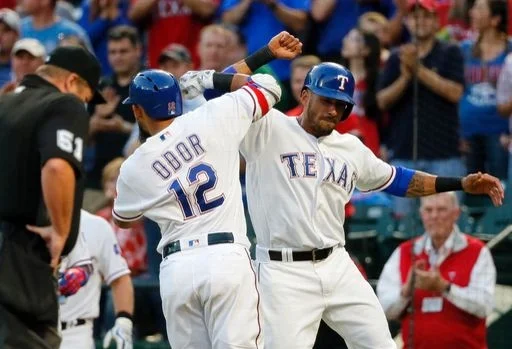
All of the Rangers scoring on the night came in the bottom half of the 2nd, with Rougned Odor (.250/.288/.429, 98 wRC+) hitting a two-run HR into the upper deck in right, giving the Rangers a 2-0 lead. 

The only other run scored on a solo HR from Houston’s Tyler White. The Rangers bullpen pitched the final 2.1 innings without allowing a run. 

The win is Texas’s 3rd straight, 4th out of 5, and 6th out of 8. They lead the AL West by 1.0 game over the A’s, and 4.0 over the Astros, the latter of which figuring to be the Rangers biggest competition in 2016. 

Tomorrow A.J. Griffin goes for the sweep against Dallas Keuchel. 

Johnny Whittleman And The Beginning Of An Era

We are about to travel to Rangers Nerdville for a few minutes, so bear with me. How many of you remember 3B prospect Johnny Whittleman? Ten additional points if you recall the monster home run he hit in the 2007 Futures Game.

As Texas’s 2nd round pick in the 2005 amateur draft, there was once a time I swore on Whittleman’s future. Granted, it was an era where position prospects in general were something of a novelty in the Rangers bleak farm system, even with Edinson Volquez, Thomas Diamond and Eric Hurley forming a three-headed monster on the pitching end. Basically if you weren’t dreaming on Johnny Whittleman to be a meaningful contributor someday, you weren’t dreaming at all.

Objectively, it can be noted that Whittleman had one truly strong minor league campaign. As a 20 year-old playing at Clinton in the pitcher-friendly Midwest League in 2007, he generated a .271/.382/.476 (141 wRC+) slash line with 14 HRs in 406 plate appearances. That was the year he somehow ended up in the same Futures Game as Clayton Kershaw, Justin Upton and Joey Votto. That’s baseball, they say.

After 2007 Whittleman began his path to washing out as a prospect, spending the next three years fluctuating between the California (High-A) and Texas (Double-A) Leagues, with a similar lack of success at both stops. He ventured to the Royals organization for the last two seasons of his career, going 2-4 with a pair of singles in his only professional appearance in a Triple-A game.

He retired in 2012.

In many respects, Whittleman represents the end of an awful era of non-pitching prospects in the Rangers organization. Only a few weeks after Johnny’s moment in the sun in the Futures Game, then-GM Jon Daniels made the franchise-altering Mark Teixeira trade (you know the names by now), as well as moving Kenny Lofton to the Indians (for C Max Ramirez) and Eric Gagñe to the Red Sox (for David Murphy and OF Engel Beltre). That was it.

The new direction of the organization was stamped that day. No longer would it metastasize with a high-priced free agent here and a John Koronka there, but rather an all-out assault on acquiring talent at every level.

It’s been a decade since the change in philosophy, and no one with a relationship to the team — from Daniels, all the way down to the last fan who has been following all these years — regrets that decision. From 2008-2015 the Rangers produced 6 winning seasons, 5 postseason appearances (if you count Game 163 vs. Tampa Bay in 2013), 3 AL West Crowns and 2 American League Pennants. To a large degree, that 2007 trade deadline was the springboard to the franchise’s relevant success (namely, back-to-back World Series appearances in 2010 and ’11), and at least partially why the club remains competitive to this day.

But now, a new nucleus is forming. Even with 20 year-old Nomar Mazara’s hasty graduation to the major leagues, the Rangers remain stockpiled with talent at the lower levels. On Friday Baseball America released its first Prospect Hot Sheet of 2016, and it included 4 Rangers: Joey Gallo (1), Andy Ibañez (3), Travis Demeritte (5) and Dillon Tate (13).

Everyone is familiar with Mazara, Gallo and Lewis Brinson, and I’m assuming you remember Jurickson Profar still plays baseball for Texas’s Triple-A affiliate. Each member of that quartet is a better prospect now than Johnny Whittleman ever was. But together they are just the tip of the iceberg.

Here are how they, as well as a couple other choice prospects, have produced over the first week and a half:

  • Gallo: .333/.432/.778 (12-36), 4 HR, 1 3B, 2 2B, 7 BB, 10 K
  • Profar: .297/.395/.378 (11-37), 3 2B, 5 BB, 7 K
  • Brinson: .286/.350/.429 (10-35), 1 3B, 3 2B, 2 BB, 6 K
  • Ibañez: .439/.489/.732 (18-41), 1 HR, 1 3B, 7 2B, 4 BB, 9 K
  • Demeritte: .378/.415/1.027 (14-37), 6 HR, 2 3B, 2 2B, 2 BB, 14 K
  • Tate: 10.2 IP, 1 run (0 ER), 9 hits, 16 K, 1 BB

This is without mentioning Luis Ortiz, who was on many top-100 lists before the season, or Brett Martin, or Ronald Guzman or Jairo Beras or Josh Morgan.

Top to bottom, the Rangers have never had more talent spread across their minor league affiliates. The only other season that compares was 2007, as is the basis for this entire article, with Jarrod Saltalamacchia, Elvis Andrus, Neftali Feliz, Matt Harrison, Max Ramirez, David Murphy, Blake Beaven, Michael Main, Kasey Kiker and more; obviously there were washouts and some, like Beaven and Main, were traded to bolster a pennant chase.

The difference now, as compared to then, is the Rangers have the luxury of being competitive in the meantime. They don’t have to wait multiple years for Andrus and Harrison and Feliz to hatch into big leaguers. Instead, the burden is having too much talent, and not enough space.

As far as prospects go, history is bound to repeat itself. Of all the aforementioned names in the current farm system, some won’t make it past Double-A, while others will be traded to help obtain pieces for the big league roster.

That is, after all, the point of any farm system: To help the MLB parent team.

So while we’re a long way removed from 2007, the course of the franchise has remained intact. It’s why Texas’s front office is regarded among the best of a handful of MLB teams. Whether it be the Astros, Cubs, or more immediately the Phillies and Braves, complete rebuilds aren’t exactly a foreign concept in the modern era. The Rangers did it a decade ago.

I miss Johnny Whittleman, and I wish he had graduated to the big leagues so all of us believers could have cashed in. But I do not miss that we once needed our prospects to succeed so that the Texas Rangers would succeed.