
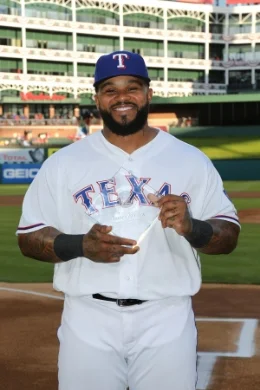
A little over a month ago, I wrote a piece talking about the trouble in banking on Prince Fielder to have a big season in 2016. At the time, I voiced some concerns over the way in with Prince tailed off during the 2015 season, and how in reality, Mitch Moreland had been the more valuable player at a fraction of the cost.
Writing this now may not exactly look pretty, considering the Rangers have only played 13 games. We’re still in the realm of things being a small sample, but perhaps large enough that we can start to see some trends. And the trends with Prince Fielder are, in a word, disturbing.
So far on the season, Prince Fielder has put up a triple-slash line of .167/.246/.229. As you might imagine, that’s not pretty. The good news is that there is plenty of time for Prince to turn things around, and a BABIP of .200 would seem to indicate that he will.
BABIP (Batting Average on Balls in Play) measures how often a ball in play goes for a hit. Then again, one of Prince’s problems thus far in 2016 has been putting the ball in play.
One of the reasons I was on board with the trade that brought Fielder to Texas in exchange for Ian Kinsler after the 2013 season was that he had, historically, been a high-walk power hitter that didn’t exactly strike out like a lot of left-handed power hitters tend to do. I thought that, even with some decline in his raw power, he would be able to get on base enough to make the whole thing worth it. In a sense, I was hoping he would continue to be effective in the same way Shin-Soo Choo is when he’s healthy.
2014 was a lost year for Prince, so it provided virtually no usable data. However, in 2015, he was voted the Comeback Player of the Year on the strength of a .305/.378/.463 triple-slash line. And yet, there were already signs that things could be headed in the wrong direction.
He didn’t walk nearly as often as he had in the past, sporting a walk rate of 9.2% versus a career average of 12.6%. He walked 64 times, his lowest non-injury total since 2006 when he was a rookie.
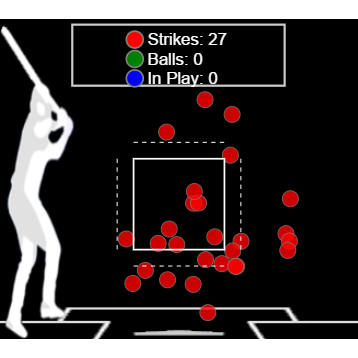
Now, in 2016, not only is the walk rate at 10.5%, but his strikeout rate is at 26.3%, his highest since he first got a taste of big league action in 2005. And if I’m being honest, it’s the strikeouts that concern me. And they concern me because of the pitches Prince has been swinging at. As you can see on the left in the image that shows his swings-and-misses, Prince is chasing pitches out of the zone. He’s also missing pitches in the heart of the zone that he once pulverized and put in the left field bleachers.
Looking at the type of contact he’s been making, I want to first point out that in 2015, Prince Fielder had a hard-hit ball percentage of 32.3%. At the time, it was the lowest since his rookie year. Thus far in 2016, his hard-hit ball percentage sits at 25.7%. It is, at the very least, a troubling trend.
Other than a three-run home run on April 6 — the third game of the season — Prince doesn’t have even one extra-base hit. And yet, he is tied for the team lead with 11 RBI. Depending on where you stand on the traditional versus new-age metrics debate, that’s either encouraging or not exactly a walking endorsement for the RBI statistic.
While even the walk rate doesn’t have a large enough sample size this season to have stabilized, strikeout rate generally stabilizes at around 60 plate appearances. Prince has 57 so far. So, three plate appearances that probably won’t make a significant impact on his strikeout rate. In all likelihood, Prince Fielder is now a hitter that swings and misses more than he did in his prime.
As a guy that makes $24 million a year — $18 million of which is paid by the Rangers — through the 2020 season, you’d like to see that left-handed power stick around for a bit longer. There was always the expectation that the back-end of the contract might look unsavory. But it wasn’t supposed to look so unsavory so soon.
Now, Prince may still approach 20 home runs before this marathon we call a baseball season is done and over. Even still, it’s beginning to look less likely that he’ll ever again approach the kind of production that his contract dictates.
I’ve pointed out previously that I think Texas could look for a trade partner to take Prince Fielder after this season, perhaps sooner if the circumstances are right. However, if he doesn’t at least start showing even flashes of his former self, it’s unlikely that anyone else will be willing to take him. And if that turns out to be the case, Prince Fielder will be taking up a very important spot in the lineup, and the Texas Rangers won’t have a whole heck of a lot to show for it.