A win against one of the winningest teams in baseball to this point? Check.
Cole Hamels got the start today, and started off strong. He struggled a bit in the latter stages, and finished with 5.1 innings pitched, 3 earned runs on 7 hits, 2 walks, and 4 strikeouts. Not his best outing, but enough to keep the Rangers in the game.
Before the offense came alive, it seemed that the Rangers might run themselves out of this game on the basepaths. First, Rougned Odor found himself caught in a rundown between 2nd and 3rd on an Elvis Andrus grounder in the 5th inning, and in the same inning, Elvis made the 3rd out when he rounded the bag too far on what appeared to be an infield hit by Delino DeShields.
Ian Desmond also had a hand in the Orioles being able to put runs on the board. In the 3rd inning, Joey Rickard hit a ball to deep left field. Initially, it looked as if Desmond would run it out, but he never really got a good read on it, looked even worse as he leaped to make the grab, and it ended up being a RBI double for Rickard. Of course, these types of things are magnified when the player in question is mired in a lengthy slump at the plate.
Fortunately, in the bottom 6th inning and the Rangers down 3-1, Desmond was a part of a monstrous run-scoring inning. To start off, Nomar Mazara doubled to lead off the inning, and after a Prince Fielder pop-up, Adrian Beltre singled to move Mazara over to 3rd. Mitch Moreland had a BABIP double down the left field line that scored Mazara, and that brought Ian Desmond to the plate. It wasn’t pretty, but an infield grounder off of his hands was just enough to score Adrian Beltre from 3rd, and Desmond was safe at 1st. The biggest blow of the inning came with Rougned Odor at the plate. With men on 1st and 2nd, Odor hit an opposite-field double that scored both Moreland and Desmond, and with the throw coming to the plate to try to get Desmond, Odor snuck over to 3rd. The scoring ended with an Elvis Andrus single to center field that scored Odor from 3rd. That gave Texas a 6-3 lead they would never relinquish.
After a rough start to the season, the bullpen has quietly been extremely effective. Tom Wilhelmsen came in to clean up the bottom of the 6th inning, Keone Kela worked the 7th, Dyson the 8th, and Tolleson closed it out in the 9th. The bullpen didn’t give up any runs, and since giving up 15 earned runs in the first 4 games of the season, we’re looking at a relieving corps that has given up 2 earned runs since. Both were off of a Nelson Cruz 2-run home run given up by Keone Kela in a 7-3 Rangers win over the Mariners on April 11. Other than that, the bullpen has been mostly a shutdown unit. Remember, the walk-off home run given up by Jake Diekman on Wednesday was unearned as the inning should have been over if not for a Rougned Odor error.
But hey, a win against a team that compiled one of the best records in baseball coming in is always good, right? Tomorrow, Martin Perez faces off against Vance Worley at 7:05 PM.
First, a quick exercise. Place yourself back in time to two weeks ago. I tell you that after 10 games, Prince Fielder has an OPS of .551, Rougned Odor an OPS of .536, Mitch Moreland an OPS of .523, and Ian Desmond an OPS of .269. Furthermore, I tell you that Shin-Soo Choo is on the disabled list for 4-6 weeks and Robinson Chirinos for 10-12 weeks. I then tell you that the Rangers are 5-5 and only a half game back of the AL West lead. A quick show of hands: How many of you would believe me?
If you raised your hand, you’re either almost ready to cash in on last night’s Powerball winnings, or you’re lying.
Yes, we’re talking insanely small sample sizes and singling out a few guys while leaving out other details. Even still, we have last season’s Comeback Player of the Year, one of 2015’s young breakout players, a 1st baseman coming off of a career season, and the biggest free agent signing of the offseason. Shin-Soo Choo had one of the strongest finishes in baseball last season, and Robinson Chirinos was the team’s starting catcher. A lack of productivity from those players — whether due to ineffectiveness or injury — would seem, on paper, to be a sure recipe for disaster.
Fortunately for the Rangers, they have some guy named Nomar Mazara to fill in while Choo is out. Catcher is one position you can usually patch up from an offensive standpoint. And for the most part, everyone else listed is due for regression to the mean — in this case upward.
Of course, by now, you’ve noticed by the headline that I’ve chosen to focus on only one of those players, one Ian Desmond.
Desmond, a relative newcomer to most Rangers fans, was a late free agent addition after it was revealed that Josh Hamilton would miss the start of the season. A shortstop by trade, Texas signed him to play the outfield. Initially, the thought was that he would be strictly in left field, but it appears we could see him increasingly in center field as Jeff Banister sees fit.
And truthfully, the outfield experiment is the least of the worries Texas should have regarding Ian Desmond. Thus far, he’s easily been the best defensive outfielder on the team. Other than an interesting misplay in left field during yesterday’s series-finale in Seattle, he hasn’t really looked overmatched in the outfield, even looking sensational at times.
His story at the plate, however, is a different story. As mentioned above, he now sports a shiny .269 OPS. His wOBA of .134 is 5th worst in MLB for qualified players. In fact, he’s got more plate appearances than any of the players “ahead” of him on that list with 42, and you’ve got to go down to Kevin Pillar at 27th to even find anyone else with 40 plate appearances.
In other words, it’s fair to say that Ian Desmond is struggling more than any other Major League regular right now at the plate. If you’re a glutton for punishment, you could also look at his wRC+ of -34 — that is, 134 percent below league-average — or his 13 strikeouts in 10 games, putting him on pace for 211 strikeouts.
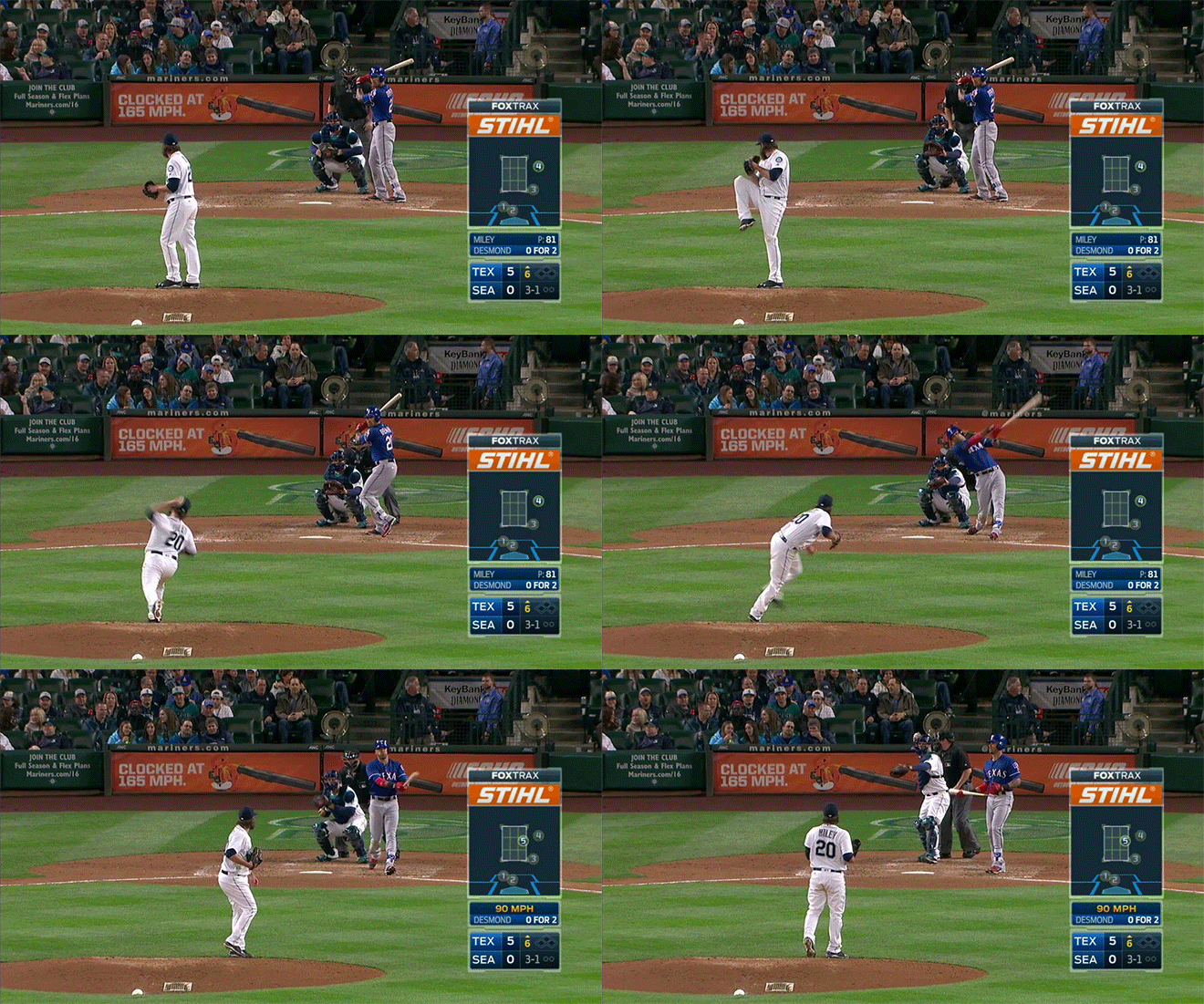
He won’t get there, even if for no other reason than it would surprise me to see him play all 162 games. Nonetheless, this GIF from Tuesday night’s game seems to perfectly encapsulate the struggles of Desmond thus far.
That’s a 90 mph fastball from a left-handed pitcher, placed right in Desmond’s wheelhouse. And he totally whiffs on it.
To be fair, and to reiterate, we’re only 10 games into the season. A BABIP of .154 is almost certainly not going to hold up. Desmond is going to start seeing some hits fall, and his huge swing will result in some hot streaks (as well as cold streaks). It just so happens that his season started on one of the cold streaks.
The real problem we run into is that, at this point in his career, this is just who Ian Desmond is. His strikeout rate crept up from 22.1% in 2013 to 28.2% in 2014. Then it jumped up once again in 2015 to 29.2%. So his 31.6% that he’s put up thus far in 2016? Probably not all that far out of line from what we can expect from him, especially since strikeout rates tend to stabilize at around 60 plate appearances. Even with some improvement, we’re probably still looking at a player that strikes out in about 30% of his plate appearances.
At this point, the biggest obstacle facing Ian Desmond is simply making contact. He’s put 26 balls in play, and it’s resulted in 4 hits. If we’re being honest, one of those hits was a weak roller against Seattle that he simply beat out with speed.
All told, at $8 million, Ian Desmond isn’t a huge deal as far as sunk costs go. He’s going to get better than he has been in his first 10 games in a Texas uniform. How much better? That remains to be seen. It’s going to be a matter of him managing to make more solid contact going forward. It won’t surprise me terribly to see a day off in his future.
I want to see Ian Desmond have some measure of success here. He’s been fun to watch in the outfield, and his raw athleticism is impressive. With that said, I do wonder how the outfield picture looks a month from now if he’s still struggling and Texas has Choo and Hamilton back in the fold. It’s too early to say, but it surely can’t get any worse.
(Note: This was originally written early Opening Day. Since it involves some fortune telling, I’ve left most of the piece intact, but there have been a few edits that may or may not have been affected by Texas’ first trip through the rotation.)
This is the time of year to prognosticate which players are going to be “key” to the Texas Rangers’ success, and exactly how successful the Rangers will be on the diamond. Jamey Newberg and Ben Rogers discussed, in the debut episode of their new short podcast Spitballin’, that Derek Holland, Martin Perez and Delino DeShields, Jr. were their picks as key players for the Rangers. I agree that two of those players are key, but not, strictly speaking, because the players’ individual performances can elevate the team that much. Before we move on, a warning: I don’t like making declarative statements that can be easily disagreed with, and I want to stress that this is all based on my opinions.
DeShields, Jr. was a highly rated infield prospect from the time he was drafted until rumors of “lack of effort” ostensibly bumped him off of Top 100 prospects lists. He played rookie ball in 2010, was promoted to A in 2011 and struggled, albeit with 30 stolen bases. Delino repeated A-ball in 2012 and played like an All Star. He was promoted to High-A ball late in the year, where he once again struggled with everything but stolen bases. DeShields started 2013 at Rookie-level again, played himself back to High-A quickly, and again played at a high level with a .317 batting average and 51 stolen bases. In 2014, with rumors about his effort surfacing, he started at AA Corpus Christi and once again, except for stolen bases, struggled to hit. Houston, at this point, apparently considered him a busted prospect and left him unprotected in the 2015 Rule Five draft, when he was selected by Texas. He was used as a fourth outfielder, something that suited his speed, and was eventually placed in center field when a combination of DeShields’ on-base percentage and Leonys Martin‘s poor bat and injuries forced a change at the position.
Starting 2016, the Rangers’ outfield consists of Shin-soo Choo, Ian Desmond, Delino DeShields, Jr., Ryan Rua, and Justin Ruggiano(editor’s note: Ruggiano has since been DFA’d). Waiting in the wings is, possibly, Josh Hamilton when (if) he returns from the disabled list.
There are rumblings that Ian Desmond may be moving to center field at some point this season. He’s been making the catches there. While he’s certainly not nearly as fast as Delino (not many in MLB are), he has a cannon arm, good throwing accuracy, and possibly a better instinct for the outfield than DeShields.
But what about DeShields’ on-base percentage being a “catalyst” for the Rangers last year? Well, I went and looked up what it was. OBP isn’t an interpreted stat, it is what it is. Here’s how it went:
Me: “Oh, there’s Prince Fielder at ’10’ and Shin-soo Choo at ’12’. And they both only had good halves… be really nice if they could both have good years.”
Me: “Nick Markakis. Damn. He doesn’t do much but get on base. Nelson Cruz… I guess he did more than just hit home runs last year… Kendrys Morales… didn’t expect that. Time to turn the page….”
That’s not bad. DeShields was in the top 100 players in On Base Percentage. I had to set minimum plate appearances at 300, which put DeShields at 76 out of 268. That puts him outside of the top 25%, but better than 33%. So, not really *elite*, but certainly *good*. He had the third-best OBP for the Rangers, slotted between Prince and Choo, and Moreland and Beltre.
The problem is that Delino produced at a below-average level offensively, somewhere between his poor minor league years and his good minor league years. Closer to his poor years, but unfortunately in-line with the usual decrease most minor-leaguers make as they advance to higher levels. While his speed is elite and his plate discipline is providing at least part of a good offensive threat, DeShields is out of place in center field and there’s no real reason to expect him to increase his offensive skills.
The bottom line is Delino DeShields, Jr. is an everyday outfielder ONLY on a lesser team, no matter how many kind words he receives for being a “catalyst”. With Rua, Ruggiano, and likely even Desmond outperforming him offensively, I see DeShields on the bench by the end of May at the latest. Barring player moves and injuries, of course.
To put it bluntly: Unless Delino DeShields, Jr. is producing offensive value at an increased level, his presence on the bench as a fourth outfielder/speed substitute will be the best indicator that the outfield is healthy and contributing to a winning team.
TO BE PERFECTLY CLEAR: I am NOT saying Delino DeShields, Jr. is a bad player, or has no value to the Rangers. I AM saying he is lacking as a center fielder, which can be improved; and he wasn’t as significant an offensive threat as he’s has been talked up to be, and there’s no reason to believe he’ll be better this year. Which can be improved, as well. And the fastest way to improve is by using other players who are better than he is.
One week in: Delino is batting to the tune of a 85 wRC+ (100 is average), against a 94 last year but in-line with most projections. His OBP is outstanding. There isn’t really enough information to judge his defense statistically, but I think all of us have noted his noodle arm costing bases already. ………
Now let’s look at the pitching staff. I have to be forward here; I’m concerned about Texas’ starting rotation. I know a lot of Texas fans find this an absurd point-of-view, but I hope you’ll stay with me on this.
I’m not worried about Cole Hamels. Hamels is on the bubble of age-related decline, but there’s an increasing, though inconclusive, body of evidence that top-flight, durable pitchers can fight off the effects of aging. Additionally, Hamels had an interesting year in 2015 as he was less effective than he had been, yet managed to work through a move to the American League that necessitated a change in style. Cole finished the year managing to turn decreased peripherals into the kind of performance you expect from your headlining pitcher. Like Darvish, even in bad games he limited damage and maintained control into the sixth or seventh inning, giving the team a good chance to win.
I’m not worried about Martin Perez. His stuff plays; his only liability is a tendency to lose control of his emotions, and therefore lose control of his body. However, before tearing his UCL, Perez was showing that he could maintain composure… I’d imagine the key is going to be forming a strong relationship with his catcher and with pitching coach Doug Brocail.
I’m not worried about Colby Lewis. Colby has already shown this year that he’s going to, barring injury, give Texas another year of the same. He’s going to once again define the idea of a #4 pitcher: someone whose reliance on command and fly-ball tendencies mean he’s going to give up runs and home runs, but he’s going to do it in such a reliable and predictable manner that you don’t really worry about it at the back end.
I’m not worried about the fifth starter. Which is to say, I’m as worried about the fifth starter as everyone is always worried about the fifth starter. It’s the fifth starter. A position that is increasingly just the “spare” starter, rather than a weekly matchup. Have you noticed that? Fewer teams have a named, consistent “fifth starter”. It’s just “one of the other guys”.
Anyway, I bet you figured out who I’m worried about. The only question is, “Why am I so worried about Derek Holland that I listed him as one of the dominoes of the Rangers’ season?”
Holland was the 748th pick in the 2006 draft. He performed well in 2007 in Low-A and performed even better in 2008 in High-A and AA. Notably, he struck out 10 per 9 innings, walked 2 in the same span, and gave up almost 0 home runs. In 33 games with the big club in 2009 he didn’t do so well, but still created positive value. Derek went to AAA in 2010, pitched well despite lower strikeout and higher walk rates, and managed to increase his performance slightly when called back to the Rangers. In 2011, he pitched 198 innings for the Rangers and won 16, despite a still-decreasing strikeout rate and a walk rate that was still 3 per 9.
The hope was that now that he had a full season behind him, Holland would begin to add his great peripherals back into the mix in 2012. Except for an almost 50% increase in home runs allowed, he was largely the same pitcher. Fans (and coaches) noted his habit of losing control and frequently giving up his runs in bursts in one inning; sometimes pitching coach Maddux and manager Ron Washington could coax him through the inning; sometimes not.
So once again, hope was put on 2013 for Holland to finally develop completely. And it finally happened, at least to the extent that it probably ever could. Derek pitched over 200 innings, got his K rate back up to 8, kept his walk rate under 3, and cut his home runs allowed by 50%, back to less than 1 per 9. Holland finished the year with a 3.42 ERA, a 3.44 FiP, a 3.68 xFiP, and generated 4.3 fWAR.
THIS was the pitcher Texas had been expecting. Or at least, as I said, close enough to expectations to be completely acceptable. This is a guy you could pencil in to that #2 slot that “Hollywood” Cole go-sit-down-now-Kyle-Seager Hamels will occupy in a rotation headlined by Yu Darvish.
And then it all came crashing down. Again. Literally.
Before the season started in 2014, Derek fell down some stairs and micro-fractured something that you can’t pitch with if it’s micro-fractured.
BUT… when he came back from rehab and conditioning, right at the end of the season, he pitched in 6 games, winning 2 and ending with 1.46 ERA and… 2.19 FiP, and 3.72 xFiP, so there was a lot of luck involved… and his lowest K rate ever except for 9 official innings at Round Rock in 2012… but his walk rate was good, and he allowed no home runs.
What to make of this? The peripherals are a mess, which, honestly, you should probably expect of someone who almost lost an entire year of baseball.
So… 2015… Derek Holland tears up his shoulder in his first game of the year. He comes back after the All-Star Break and pitches in 10 games. His K rate is still around 6 per 9, his walk rate is still around 2.5 per 9, his home run rate is back up to 1.5 per 9; he pitches to a 4.91 ERA, a 5.30 FiP, but also a 4.45 xFiP, so that’s… not very good, but should have been better.
Holland should have been almost as good as Colby Lewis, instead of worse.
Projections all say he’ll be about as good as Colby Lewis has been going forward (they all say Colby Lewis won’t be as good as he has been going forward). And *that’s* only if Holland is healthy enough… his projected value is based almost entirely on his ability to take the ball for 150+ innings.
In other words, Derek Holland, as befitting all evidence, is likely to be the third fifth starter, slotting between Colby Lewis and whoever the other guy is.
So, to start the year off, Texas will have a solid TORP, Cole Hamels, followed by Martin Perez, who should be a solid MOTR starter, with probably enough upside to look like that farm-developed #2 pitcher Texas has been desperately seeking for years. The guy Derek Holland was supposed to be. After that Texas will throw out Colby Lewis, who will probably have a few games this year where he flirts with shutouts and complete game wins, and quite a few more where you’ll be glad he made it through five giving up a run per inning. But he won’t actually blow up very much, and those few gems he pitches make it all worthwhile. A #4 starter with ton of “grit.” And then you’ve got the guy I’ve decided to call Russel Stover this year. You know Russel Stover. The “box of chocolates” company.
Except, honestly, we know what we’re gonna get. Probably. Derek Holland is the last man in the rotation who is guaranteed a spot if he’s healthy. He’s not getting traded, not now. Unless… never mind. If he pitches well, his option next year is so cheap it’s a no-brainer to pick up. If he pitches poorly, then he’s your default #5.
That’s why Derek Holland is my pick for the other key “domino” player. Because if I’m right, there’s a huge hole in the middle of the rotation right now, and we’d better all hope Yu is in good form when he comes back from Round Rock or Frisco in six to eight weeks. Yu/Cole/Perez/Lewis/Holland isn’t perfection, but it’s pretty darned good.
If Holland “regresses” back up, to a form he hasn’t had for a few years, then everything is fine. If he really is the worst pitcher in the rotation… then that sets the dominoes in motion, because a World Series hopeful needs another pitcher up there in the 1-3 slots… not another pitcher than can fill in the #5 slot. Those guys are cheap.
After the first week: Cole Hamels had a great start, except for home runs. I doubt that’s a long-term problem. His peripheral stats indicate that, except for the home runs, he pitched wonderfully. I know a lot of people are going to read this and say “no duh”, but I would like to stress that the statistical measurements basically say that Cole made a handful of bad pitches, and all the rest of them were very, very good. Not worried
Martin Perez: walks. We knew this. Attack the zone. Also, did you watch the umpiring in that game? I’m not sure how much I’m going to put on Martin.
Colby Lewis: Below average for Colby, but not by much. It’s OK. He beat his xFiP.
Derek Holland: He pitched in-line with projections. Statistically, he was on par with Lewis.
A.J. Griffin: Texas has one pitcher who has produced positive value by fWAR. It’s Griffin. But don’t get too excited… while his ERA and FiP were in-line, walking twice as many people as you strike out leads to an xFiP of “STINKY”. Now, Texas has spent a fair bit of time fielding pitchers who get outs via the ground ball almost exclusively, so it’s possible Texas can make this work. Anyway, congratulations to A.J. Griffin, the Rangers’ best starting pitcher in the first week!(?)
After months of life without real baseball, the day has finally arrived. Today, at approximately 3:05 PM, Cole Hamels will toe the rubber, wind up, and pitch. And with that, baseball will have arrived.
I’m not here to tell you that there’s some inherent magic in the day itself. That somehow, the success or failure of Opening Day is some sort of omen or microcosm for the entire season. What I will tell you, however, is that today is Game 1 of 162 — and hopefully more, if things bounce the right way.
We can all point to our favorite predictions and projections to make our cases for where things might end up, but now, the club will actually take the field to prove it. And that’s the fun of baseball.
Without actually playing the games, you don’t get magical moments that come with baseball. You don’t get Josh Hamilton hitting a walk-off home run against the A’s in 2011. You don’t get Eric Nadel’s magical call of the Rangers clinching the organization’s first World Series appearance.
Sometimes those moments go the other way, such as when Texas blew a 4-run lead on the next-to-last day of the season in the 9th inning. And even when those moments hurt as a fan, they’re part of the entire experience.
I’ve long said that sports are the best reality television. You can disagree with me on that if you want, and I won’t fight you on it. Just know, you’re wrong.
And whatever happens today in Game 1, I know that it has almost no predictive value on the other 161 games that the team is guaranteed to play. Win or lose, we get a solid 6 months of baseball afterward.
Before it’s all said and done, Yu Darvish will be pitching once again. Ian Desmond will try his talents in the outfield. And we might even get a redemption story in Matt Bush somewhere along the way.
And no matter how things turn out, there’s sure to be some bumps along the way. After all, in baseball, you’re going to win a third of your games and lose a third. It’s what you do with that remaining third that determines how good you are. That’s how fine the line is between success and failure. However that final result ends up defining this 2016 club, I personally can’t wait for first pitch to get that journey officially started.
2016 is supposed to be a big year for the Rangers.
Unlike last season, where 60% of the starting rotation — Yu Darvish, Derek Holland and Martin Perez — was on the disabled list for most or all of the year, this club’s (promising) health is one of the more evident takeaways from a fairly innocuous spring training.
So if the health is okay, and if the Rangers are coming off an 88-win season where they won the AL West and came within two innings of reaching the ALCS, what negatives are there to find?
Yu Darvish is set to return to the mound in mid-to-late May; Jurickson Profar, Joey Gallo and Nomar Mazara are within months (or maybe weeks in Jurickson’s case) of getting called up to help the major league club; this is as complete of a Rangers team, on paper, that we have seen since 2012.
The issue — that some fans will likely disagree with me on — is that last year was an aberration, and this year Texas will have to “earn it,” so to speak. According to Jonah Keri the Rangers were only an 83-win true talent team in 2015, while the Astros were really a 94-win team. But based on remarkable sequencing, and that Houston went a mere 21-29 in one-run affairs, the Rangers came away with 88 wins to the Astros’ 86 and took the AL West crown for the third time in six years.
It isn’t a secret that the Rangers and Astros figure to be the two teams with the best shot and capturing the division in 2016, as well. According to Bovada, Houston is opening at +125 ($1.25 for every $1) to win the division, with Texas as the first underdog at +275. Anaheim and Seattle follow them at +400 apiece.
This is an interesting opening line for a couple reasons.
One, just a month ago I wrote that Houston was +160 to Texas’s +210 to win the division. In just four weeks, with nothing but spring training to latch onto, the Rangers basically went from 2:1 underdogs to nearly 3:1, and the Astros went from time and a half to where they’re at now, which is almost even money.
It’s clear the wise guys like the Astros to do very well this year.
That isn’t to say the Rangers can’t have a strong campaign themselves, or that Houston is immune to bad luck for a second straight season. It’s simply the logical stance: The Astros are a year older, and their core is either ascending or already in its prime. There is every reason to expect them to be better in 2016 than they were last year.
Texas, meanwhile, is old(er). Its big money players are either post-prime (Cole Hamels, Prince Fielder, Adrian Beltre, Shin-Soo Choo) or searching for a prime (Elvis Andrus). And much of the next wave of talent won’t be penciled in to the regular lineup until 2017, when Joey Gallo, Nomar Mazara, Jurickson Profar and Lewis Brinson could all reasonably be ready for consistent big league action.
With the signing of Ian Desmond to presumably play center field, and with a flush bullpen and Yu on the mend, this is an all-in year for the Rangers. One way or another, through utter collapse or another American League pennant, this roster is getting turned over next season.
Now, indeed much shit will go down in the meantime. It will just be a matter of how well the Rangers do in slowing the aging process. Right now, there’s an understandably sharp divide between Rangers fans and Las Vegas when it comes to the club’s 2016 expectations.
This is all without mentioning that most computer forecasting models (that I know of/follow) never really cared for the Rangers to begin with. PECOTA (79-83) and FanGraphs (80-82) both predict a sub-.500 finish for the Rangers, and ZiPS trended toward that direction as well. So it goes.
On the other hand, you have national writers like Tom Verducci and Ken Rosenthal who predict the Rangers will defeat the Cubs in the World Series, and Jerry Crasnick thinks Texas knocks off San Francisco for the title. (Oddly, Rosenthal picks Houston to win the West, but for the Rangers to procure the ultimate prize. Seems like a good way to satisfy two fan bases and one large state at the same time.)
If ever there’s a time to check yourself in the mirror, it’s when mouthpieces like Verducci and Crasnick pick your club to win the damn thing. Then and only then did the idea enter my brain that something here wasn’t right.
You have Vegas, FanGraphs, PECOTA and ZiPS all basically saying the same thing, that the Rangers will be average to slightly above average, a range of about 80-84 wins. Then you have Rangers fans — each of whom is completely objective, of course — largely voicing optimism, that this is really a 90-plus win team that will compete with the Astros in the West.
If you asked me, I would be the boring guy who sees it somewhere in the middle. I mean, it doesn’t take a lot to convince me that this team can win 90 games. Assuming health, by June 1st the rotation could go Darvish-Hamels-Holland-Perez-Lewis, and the lineup could feature Rougned Odor and Jurickson Profar batting 1-2 with Beltre, Choo, Fielder and Mitch Moreland to provide (a little) punch behind them. There should be enough offense to go around, or at least enough support for a pitching staff that could look deadly if everyone is healthy.
Much, obviously, rides on two pitchers for the Rangers: Derek Holland and Martin Perez. Texas gets docked significantly in the computer projections for having so many players spend so much time on the DL in recent years. Holland and Perez would each fall in that category. If they pitch how much they are projected to pitch, which is around 100 innings in both cases according to ZiPS, then Texas is going to have a helluva time making up those extra innings with Nick Martinez and Chi-Chi Gonzalez.
But if they pitch to their capabilities, which is something we’ve been dreaming on for the last half-decade in Derek’s case, then Texas has two strong #3 starters with upside. If Holland and Perez manage to stay on the mound for 180-200 innings in 2016, and put up ERAs in the mid-3’s, then the Rangers can take down the West.
There is, however, an unavoidable flip side to that coin, one where Prince Fielder and Shin-Soo Choo are worthless, where Elvis Andrus continues not to hit, and where Delino DeShields regresses in his second full year. I hope against this scenario very much, as you can probably imagine, but it illustrates just how delicate the line is between finishing with 79 or 80 wins, or 89 or 90 wins. We could write this about any team, but the probability is higher with Texas because its roster has proven to be severely fragile the last few years, and it won’t be getting any younger until 2017.
I like the Rangers to make the over on 83.5 wins, but 90 is pushing it. I would love for the club to be in a position where they are within a few games of Houston come September, where they would have the ability to play their way — head-to-head — to a division title, and still have one of the two Wild Card slots as a fallback option. The Astros are going to be a problem in 2016, so as long as the Rangers’ veteran roster is within striking distance to give themselves a shot at knocking off the upstarts for a second straight year, I would consider that a win this season.