Skip to content

Home

Not Real Baseball: 2016 Rangers Fantasy Value

I’m ready for baseball.  

I’m ready for real baseball.  For games that count. For stats that matter.

I’m ready for more fake baseball (no, not extra spring training games).

I’m ready to root on the Rangers while answering tweets from random baseball fans who are checking on the possibility of minor league players getting the call up to the bigs.  

I’m ready for my life to be engulfed by numbers: 162 games, 40 man rosters, 108 stitches, 90 feet at a time.  

Let’s do this thing.

As we enter into the last week of spring training and the last week for you to get your 2016 fantasy squad together, let’s take a look at the fantasy value of Rangers’ players and potential projections for this season’s production.  
 

As usual, the Ranger carrying to most fantasy value is our future Hall of Famer and clubhouse leader in head touching phobia, Adrian Beltre.  Every year, someone projects that he will have a big drop off.  Every year, he continues to put up big numbers, even while fighting through injuries and surpassing third basemen that everyone assumed would outlast his value, such as David Wright and Evan Longoria.  Expect another well balanced season from Beltre, hitting .300 with 20 HR, 80 RBI, and 70 R from a thin position.  His ADP is 62.8, so don’t be scared to grab him a round early to make up for position scarcity.  

Prince Fielder has been the second Ranger off the board in most leagues, with an ADP just three spots behind Beltre.  His weak power numbers and cold streak following the All Star break make Fielder a big question mark for someone who did not play enough games at 1B to qualify for that position in standard ESPN leagues.  I’m wary to grab Fielder any earlier than where he is going, with that thought process being much more closely tied to his second half performance rather than any fear of injury.

I am finding that I like Rougned Odor as much in fantasy baseball as I do in actual baseball.  If you eliminate the first month of the season, Odor’s numbers match up with just about anyone in the upper tier of second basemen.  Odor had 12 homers and an .833 OPS in the second half of the season.  Realistically, Roogie is looking at a potential 20 HR, 20 SB season with a BA around .270, with 65 runs and 70 RBI; yet his average draft position is 25 spots behind the man he replaced, Ian Kinsler, who hit 11 HR and stole 10 bases in all of 2015.

Elvis Andrus is the guy you wait for if the top tier shortstops are not available.  Will he win your league for you?  Nope.  But he probably won’t lose it for you either.  While providing no power, Elvis will hold his own in batting average thanks to a low K rate, and if he regains patience at the plate and continues to increase his OBP, Andrus will provide nearly 30 SB this season.

Similar to Andrus, Ian Desmond receives a spike in value due to the position scarcity at SS.  But isn’t he just out outfielder this season?  Correct, but thanks to last year, ESPN has him listed as a shortstop, and after the first ten games, he will be eligible for SS or OF.  If I had to choose between the two Rangers options for your SS opening, I would go with Desmond, because even though he has a lower floor, he also has a much higher fantasy ceiling than Andrus, and I expect a solid bounce back season in a free agency year.

Shin-Soo Choo is free falling in drafts thanks to disappointment he provided fantasy owners during most of his previous two seasons in Texas.  However, this Choo seems much closer to the old version, sporting a 1.016 OPS (yes, that’s the real number) in the second half of the 2015 season.  Currently going 129th overall, Choo is worth a shot earlier than the 13th round of your draft.

Delino DeShields marks the end of the Rangers offensive regulars who should be rostered in all leagues.  While Delino won’t provide power numbers, his potential for 35+ steals over the course of a full season, with the addition of 90 runs out of the lead off position.  However, temper your expectations for a higher batting average until he can find a way to lower his K rate, striking out in nearly ⅕ of his plate appearances in the second half of 2015.

While the AAA three headed monster may have some value in deep keeper leagues or in leagues with a MiLB portion of their draft, I would not expect anything from Joey Gallo, Nomar Mazara, or Lewis Brinson this season.  If I had to pick one of them, I would say that Mazara has the most MLB ready bat, but I still wouldn’t bother. Gallo is currently owned in 33% of all ESPN leagues, which is higher than Mitch Moreland (28%).  We all know the holes in Gallo’s game, and I hope to see him have an opportunity to continue improvement.  Jurickson Profar provides questions that I just can’t answer, and I have no idea when to realistically expect to see him in the big leagues again.

If you are considering drafting Josh Hamilton as a late round sleeper; stop it.  No.

In a rare situation, the Rangers also offer a fair amount of value to fantasy pitching staffs this season as well.  

The man who will get the ball on opening day ranks the highest in Rangers fantasy pitching value, with Cole Hamels, who is currently being drafted 111th overall.  Hamels is a workhorse who will benefit greatly from the quality bullpen behind him.  Standard expectations for Hamels would be a 3.50 ERA with 200K, sporting a K/9 of somewhere very close to 9.0.

Yu Darvish is falling all the way to the 192nd pick and with good reason, due to his return from Tommy John surgery.  However, if you can afford a roster spot to to stash him, or if your league provides a DL spot, grab him and keep him there until he finds his way back to the mound in late June.  Darvish is good enough at his job that he can make a difference in limited time, showing this ability in striking out 182 batters while only making 22 starts in 2014.

The closer’s job belongs to Shawn Tolleson, who was outstanding in 2015 until some strange usage in the last few weeks of the season and postseason threw Rangers fans for a loop.  If he can mentally recover from that, while maintaining a lower HR rate, expect a 35-40 save season from Tolleson.  If not, be prepared to grab Keona Kela in a heartbeat (who you should already consider owning in leagues that value holds).

Both Derek Holland and Martin Perez will provide added value to teams who stream pitchers throughout the season, but neither of them should be considered for ownership in all formats until they can prove that they can both remain healthy and keep the ball in the park.  
10 Bold Predictions for 2016

The Texas Rangers open the 2016 season in less than a week, and that means it’s time for bold predictions. The expectations are high in Arlington, and the goal of another playoff run is well within reach for this team. That being said, every Major League Baseball season is long and contains plenty of ups and downs. After thinking long and hard, here are my 10 bold predictions for the upcoming campaign. Please feel free to give some predictions of your own in the comment section below.

  1. Joey Gallo Will Hit At Least 20 Home Runs

    Joey Gallo has been one of the best prospects in baseball for a number of years, and Rangers fans finally got to see him in Arlington during the 2015 season. He only played 36 games, and for the most part, he didn’t have a great first run in the majors. However, he flashed plenty of firepower on occasion and ended up hitting six home runs. 

    There isn’t a guarantee Gallo will get a lot of at-bats for Texas this season, but I’m betting on him being back in the big leagues sooner rather than later. Once he gets the call, he’ll make the most of it.
     

  2. Shin-Soo Choo Will End Up With Over 100 Walks

    Shin-Soo Choo had a dreadful start to the 2015 season, but he was a much better player down the stretch. He showed fans why the Rangers locked him up long term for big money in late 2013. While the occasional trade rumor still comes up, the 2016 season provides a fresh start for him.

    After finishing 2015 on a high note, Choo is going to have a really strong full season. He’s racked up 100 walks in a season once before (2013 with the Reds), and he’ll get back to that number in 2016. In addition, he’ll end up with an On-Base Percentage north of .400.
     

  3. Texas Will Trade For a Catcher

    Robinson Chirinos has improved in recent years, and he’s a serviceable MLB catcher. He was in the middle of the pack in offensive and defensive WAR in 2015, and if he’s the Rangers catcher all season, it won’t be a terrible thing by any means. However, his production last season is going to be about as good as we can expect moving forward.

    Where there is smoke there is fire, and the Jonathan Lucroy rumors never go away for long. Texas will finally make the move in 2016, and what goes back to Milwaukee may be mentioned a little bit later in this article. Lucroy had a lousy 2015 season, but he was in the MVP discussion a season earlier. He’d be a welcome addition in Arlington and a potential major impact player in a playoff race.
     

  4. Ian Desmond Will Lead the Team in Home Runs

    Ian Desmond has really improved his stock in Spring Training, and Rangers fans are hoping it translates to the regular season and postseason (fingers crossed). He’s flashed solid power in the past and has hit as many as 25 home runs in a season. After having a down 2015, he seems to be refreshed heading into the new season.

    Desmond is going to fit very well in the Rangers lineup, and he’s going to see plenty of good pitches along the way. He’s going to be the team leader in home runs, and that number will be pretty close to 30. He has the potential to be a 30-30 player, and he’ll get pretty close to that this season. This signing looks better every day and will provide a huge boost in 2016.
     

  5. Keone Kela Will Be the Closer By Season’s End

    Shawn Tolleson was outstanding in 2015, and he really provided a lift at the end of the Rangers bullpen. However, he’s not the long-term solution as the Texas closer. If he ends the season as closer, that’s a very good sign for the team. I’m guessing he goes through a minor slump at some point in 2016, and Keone Kela gets a chance to close out baseball games. When he gets his chance, he won’t look back. Tolleson will still be a valuable piece in the bullpen, but Kela is an MLB closer through and through.
     

  6. Derek Holland or Martin Perez Will Be Traded

    This is probably the prediction I least want to see happen because I’m a fan of both pitchers, but it’s time for the Rangers to get something productive from them for a full season. I’ve read it many times, but it always feels like “next season is the season Holland and Perez fulfill their potential.” At some point, Texas has to move on if things go like they have in recent years.

    The trade for Jonathan Lucroy was mentioned earlier, and Holland or Perez could be a major piece included in that deal. If Holland and Perez both perform great to start the 2016 season, the Rangers are going to be in great shape when Yu Darvish returns. This prediction will be completely wrong, and that’s just fine. If either or both of them struggle to start the season, however, a move of some kind has to be made.
     

  7. Cole Hamels Will Win 20 Games

    The trade for Cole Hamels last season was a surprise to many, but it ended up being a very pleasant surprise. The Rangers went on a late-season surge after the trade, and he was a big reason for that. He’ll take the mound as the Opening Day starter next Monday. 

    A full season of Hamels in Arlington is very exciting, and it very well could end up being one of his best years yet. He’s won as many as 17 games in a season, and there is potential to top that in 2016. 20-win seasons don’t fall off trees, but it’s possible. If Colby Lewis can win 17 games in 2015, Hamels can get to 20 this season.
     

  8. Yu Darvish Won’t Pitch Until After All-Star Break

    Yu Darvish’s return from Tommy John surgery tops my list of anticipated 2016 moments. He’s absolutely amazing when he has his best stuff, and he’s pretty good when he only has his decent stuff. If Texas holds things together to start the season, he’s going to return to a team with true aspirations of winning a World Series.

    The timetable for Darvish’s return isn’t set in stone, and it’s been mentioned that May or June is the goal. The Rangers need to make sure they take their time with Darvish, although everyone wants to see him back as soon as possible. If he returns before the All Star Break, it’ll be great. However, it’s much more likely the team plays it safe and holds him out until the second half of the season. He’ll be a major key down the stretch.
     

  9. The Texas Rangers Will Send Three Players to the All-Star Game

    The Texas Rangers have plenty of players with history of making it to the All-Star game, and they’ll have a decent representation at the 2016 Midsummer Classic in San Diego. Cole Hamels is going to have a great first half of the season and will be in line to start this year’s All-Star Game for the American League. 

    Closers usually get most of the relief pitcher spots on All-Star teams, but non-closers have gotten more respect in recent years. Keone Kela may not be the Ranger’s closer by July, but there’s a decent chance his numbers will warrant an All-Star nod regardless.

    The third Ranger All-Star prediction is Shin-Soo Choo. He’s going to cause a lot of headaches for opposing pitchers this season, and he’ll be rewarded with a spot in the All-Star Game. Rougned Odor and Ian Desmond may end up in the All-Star conversation as well, and either could end up being included in the fan vote for the final spot. Second base is pretty loaded in the American League, but Odor is climbing the ranks quickly.
     

  10. The Rangers Will Win 91 Games and Make an ALCS Run

    The last prediction is the one readers are probably most interested in. Texas won 88 games and the AL West in 2015, and that’s after a poor start the first two or three months of the season. With Cole Hamels for an entire season along with Yu Darvish for at least a few months, it’s very hard to imagine the team not winning more than 88 games in 2016. 

    The team could very well start the season slow again. The starting rotation is still a question mark after a shaky Spring Training for a number of pitchers. The offense should start this season better than last, so that should offset things a little bit. The team will probably stay fairly close to .500 until Darvish returns before going on another late-season push towards the Postseason.

    With the talent currently assembled at the Major League and Triple-A levels, there are very few question marks across the board. The depth is there to have a really good season, and anything less than a postseason berth will surely be a disappointment. My final projection has the Rangers winning 91 games along with the AL West for a second consecutive season. It’ll lead to a win in the ALDS before bowing out in the ALCS.

Is Mitch Moreland Due for Regression?

I can feel your cold, hard stares now. I’ve mentioned one of Texas’s favorite sons, and the fact that I included the word “regression” in the title probably has you a little more than agitated. No matter, I press on.

Mitch Moreland had a career season in 2015. He matched a career high in home runs, he put up a WAR of 2.2 according to Baseball-Reference, and his defense at 1B provided some value, especially over what Prince Fielder likely would have provided in his place.

Based on the weight of that successful season, Moreland and Texas hammered out a 1-year, $5.7 million deal immediately before Moreland would have been able to make his case in salary arbitration, a situation that Texas has avoided with any player since Lee Stevens in 2000.

All told, $5.7 million is a good buy — in terms of fiscal responsibility in baseball — for what Moreland provides. I know it’s something I bring up quite often, but an assumed cost per win of $6.5 million on the open market would end up costing Texas $14.3 million to replace Moreland at his 2015 production level. Those types of numbers are always a bit give-and-take, but give us a general guideline.

Now, I’m prepared to come right out and say it: Mitch Moreland is due for regression in 2016.

For starters, Moreland is heading into his age-30 season, and it’s been well-established that players on the wrong side of that figure tend to taper off. That issue is often further exacerbated in power hitters, a profile that Moreland more closely fits than not.

Adding into the equation that he’s never really managed to stay healthy — even an elbow injury and apparent stress fracture in his left foot hampered him in 2015 — and we’re talking about a player who isn’t likely to see a sudden disappearance of these issues in a post-30 career.

For all of the success he saw in 2015, Moreland still wasn’t very impactful against left-handed pitching. Don’t get me wrong, not every left-handed hitter can be like Joey Votto — who posted a higher wRC+ against lefties (178) than righties (170) in 2015 — but you’d still like your 1B to be able to produce better than a wRC+ of 80 against lefties, which comes in at well below-average.

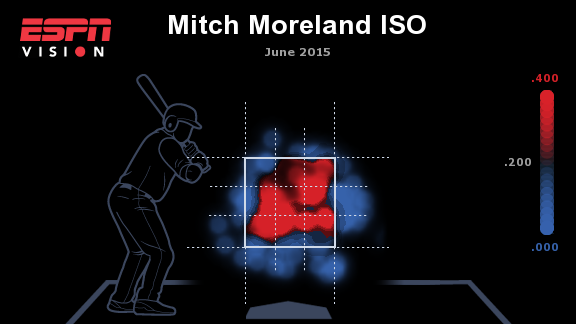
Beyond just the splits is a bigger issue. Determining exactly how much of Mitch Moreland’s 2015 success was “real”, so to speak. To expound on that a bit, most of the damage done in Moreland’s 2015 campaign was in the month of June. For starters, his ISO — isolated power, a measure of a hitter’s raw power — was .313 in June, and you can see a little bit of how awesome that was in the heat map below.

Courtesy: ESPN Stats & Information

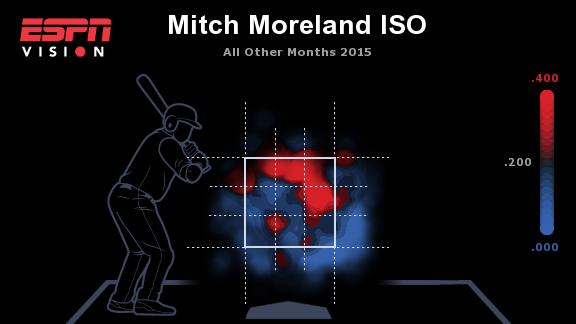
Courtesy: ESPN Stats & Information

On the other hand, for the rest of the season, his ISO sat at .181, which while still being average, was largely hampered by putting up a figure of .165 in September and October.

Courtesy: ESPN Stats & Information

Courtesy: ESPN Stats & Information

Perhaps another complicating factor was the BABIP of .365 in June. In other words, during that time, Mitch Moreland was making contact and having the ball fall for hits. While some of it is certainly attributable to an uptick in production, there’s also fair amount that might not have been directly related to any discernible skill.

The real point I’m trying to get across here is that I’m having a hard time believing that one month out of an entire season suddenly means Mitch Moreland is ready to replicate the entirety of his 2015 production in 2016. I simply don’t think it’s a realistic expectation to have. Obviously if you’re Texas, you take the power surges from Moreland when you can get them. I just don’t think you can really expect anything sustainable at or near that level going forward. And for whatever it’s worth, Dan Szymborski’s ZiPS sees Moreland worth 0.9 WAR in 2016 in 412 plate appearances.

The plate appearances bring me to my final point. In 2015, Moreland logged 515 plate appearances, only three less than his career-high of 518 set in 2013. I expect that figure to come down in 2016, pending the health of the overall team.

It appears that Ryan Rua will once again make the team out of Spring Training. Last season, his role going in was as the starting left fielder. The Rangers signed Ian Desmond for that for this season, but Rua has also been getting starts at 1B in Spring Training. It seems conceivable to me that Rua could get some starts against left-handed pitching, which would take away from the 167 plate appearances Moreland had against southpaws in 2015. That’s without considering that Adrian Beltre is another year older, and perhaps could use some days as the team’s DH, forcing Prince Fielder to play 1B occasionally.

Approaching the debate from another vantage point, we could say that Moreland getting zero starts against left-handed pitching would actually make him more valuable. And in a sense, I can get on board with that. Regardless, I’m still of the opinion that things will be down for him across the board in 2016.

All in all, I’m still glad that Texas was able to get Mitch Moreland signed. I expect that this will be his final season in Texas, as once he becomes a free agent at the end of the year, I believe there will be teams willing to pay for his services; more than Texas will be willing to pay. He doesn’t seem to be the type of player the Rangers would risk paying the qualifying offer to; on the contrary, he’s probably the exact type of player that could/should accept a qualifying offer, thereby nullifying any draft pick compensation Texas might expect to receive if he signs elsewhere.

I just can’t get myself on board with the kind of thinking that says at age 30, Mitch Moreland has somehow “turned a corner” based on one season in which he put up a WAR (2.2) that was higher than the rest of his career combined (2.0). I hope I’m wrong, but I fully expect Moreland’s 2016 to be slightly less appealing than 2015.

Does Texas Have a 5th Starter?

With 8 more games to go on the Spring Training slate, things are starting to come into focus for the Texas Rangers. Ryan Rua has all but assured himself a roster spot for a second straight season with another strong showing this Spring. The utility infielder position may be still up for grabs, but I’m not sure there will be much sleep lost over exactly which one of Hanser Alberto or Pedro Ciriaco ends up making the roster.

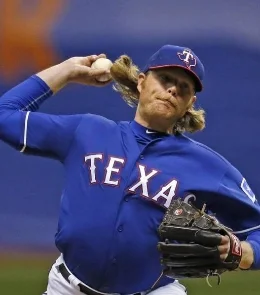
The one area that has yet to come into focus it that of the 5th starter. The Rangers will need someone to take on the role until Yu Darvish makes his much-anticipated return to the mound sometime in May-June. As I talked about recently, Chi Chi Gonzalez headed into this competition as the favorite to win the job, followed closely by Nick Martinez.

Martinez seemingly took himself out of the running by giving up 11 earned runs in 11.2 innings pitched in Spring Training, but he’ll get a chance today to redeem himself and possibly place himself back into the mix. That’s where the Rangers find themselves; no one has stepped up to seize the job as their own.

It’s not for lack of trying, of course. Chi Chi Gonzalez has likely only remained in the running over Martinez simply because of his pedigree. That is, he slots in higher on the prospect “food chain”, if you will. I’m not saying it’s fair, I’m only saying what it is.

And as we’ve addressed here before, the problem with Gonzalez in 2015 was the strikeout-to-walk ratio of 0.94. That is, he actually gave up more walks than strikeouts. In delving a bit deeper to look for an appropriate comparison, I could find none in 2015. The closest I could really come up with (and only if I really lowered the minimum innings pitched threshold)? Matt Harrison.

The same Matt Harrison who pitched 16 innings for Texas before being tossed into the Cole Hamels deal. The same Matt Harrison who very well may not pitch again as he once again deals with back pain. To be clear, a healthy Matt Harrison was a solid pitcher, a middle-of-the-rotation pitcher, a guy you’d love to have a player compare to. But the Matt Harrison we saw pitch in 2015 isn’t a good comp.

We can go back and forth talking about a results versus peripherals discussion on Chi Chi Gonzalez. One camp will say that it’s only the results that matter, and that his 3.90 ERA in 67 innings bears that out. The other side will point to the xFIP of 5.26 and SIERA of 5.59 and say that he’s due to regress at any point.

And without a doubt, you take the 3.90 ERA from your 5th starter, provided you can get it. The really crux of the issue at hand is that ERA generally doesn’t provide much predictive value on what a pitcher might do going forward. As it’s so dependent on not only the pitcher, but the defense behind him, things get lost in the shuffle.

When we look at his peripherals, we get a better idea of what we can expect him to do going forward. So, a K/BB ratio of 0.94. We’ve established that’s not good. At what point does this stabilize to potentially show us a trend? If we ask Baseball Prospectus for their handy chart, we see that strikeout rate tends to stabilize at 70 batters faced and walk rate at 170 batters faced; both thresholds that Gonzalez crossed in 2015.

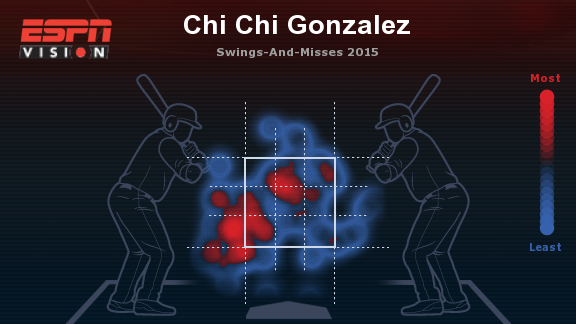
For reference, I decided to take a look at what kinds of swings-and-misses Gonzalez managed to induce in 2015. And here they are:

Courtesy: ESPN Stats & Information

Courtesy: ESPN Stats & Information

For a pitcher that is supposed to have a changeup that he mixes in with things, it appears that Chi Chi’s biggest problem has actually been getting hitters to bite on it, probably attributable to there being only a 5 mph average difference between his fastball and changeup. Ideally, you’d like to see the changeup dropping below the strike zone, fooling hitters, and inducing both whiffs as well as weak grounders. The logic goes that the more strikeouts a pitcher induces, he thereby also is able to induce weak contact. That just hasn’t been happening, and the changeup needs to be dialed down lower than an average velocity of 86 mph.

So we have a trend, some stabilized peripherals, but the pitcher in question is only 24, so there’s time to turn this around, right? That’s where we just don’t know. Certainly Texas would like to see those things turn in the other direction. Even the 2.56 K/BB rate Chi Chi put up at Double-A Frisco in 2014 would be a solid improvement. That would put him somewhere a little closer to Ubaldo Jimenez in 2015. Still not great, but for a 5th starter, certainly usable. And I doubt anyone will thumb their nose at a 2.7 WAR from that portion of the rotation.

And finally, we get to where things stand today. Chi Chi Gonzalez isn’t, at least so far in Spring Training, turning this thing around. He’s pitched 13.1 innings and given up 7 walks. He only just yesterday recording his first 2 strikeouts of Spring Training. In this case, the sample is too small to reliably gain anything from it, but when it comes to the position battle at hand, it’s what we have to go with his 2015 resume. And so far, that resume just isn’t that good.

As much as I hate to say it, barring some changes in Chi Chi’s repertoire, I’m just not sure he can reach that middle-of-the-rotation potential that Texas has pegged him for. I sure hope I’m wrong, but as it stands right now, it’s not looking good.

Exacerbating the problem is that the guy that appears to be the next-best option, A.J. Griffin, is a bit of an unknown. He’s still on the road to recovery from Tommy John Surgery in 2014, and hasn’t pitched in a Major League game since 2013.

The good news is that he’s missing a lot of bats, compiling 13 strikeouts against 2 walks in 14.1 innings of work. However, it’s simply hard to tell how ready he is to handle the workload of a starting pitcher just yet.

If I had to put forth my best guess, I’d wager that Griffin is the favorite for the 5th rotation spot. Failing that, it all gets a little bit muddy, and I’m just not sure that Texas has a legitimate 5th starter on their roster if Griffin isn’t the guy once the calendar turns to April.

Follow Brandon Land on Twitter @one_strike_away

How Ian Desmond Could Give Josh Hamilton Playing Time

In yesterday’s Cactus League tilt against the Cubs, Matt Bush stole the show. His 2 innings of scoreless relief were nothing short of spectacular — at least as far as Spring Training results go — and came from a player who hadn’t touched a baseball in well over two years, no less.

Another thing that happened in the 5-0 Texas win was the Ian Desmond got his second start of camp in center field.

Desmond, of course, is undergoing the conversion from shortstop to left field. The Rangers have apparently decided to get a look at him in center field. With Delino DeShields exiting Tuesday with what the Rangers are calling biceps tendinitis, it’s probably prudent for Texas to explore all options in case a contingency plan is needed at any point this season.

In the 1st inning, Desmond drew back toward the center field wall and made a basket catch before turning and throwing a strike to first to complete the double play. In the 3rd inning, he ran up to quickly field a single to shallow center field and threw such a beautiful strike to home plate that Munenori Kawasaki didn’t even bother sliding. That’s how far out he was.

These plays marked the second and third times this week that Ian Desmond has managed an outfield assist, showing that his athleticism and arm give him a versatility that allows him to play all over the field.

That’s not to say that Desmond is suddenly one of the best outfielders in the game, but he has the tools to make that translate for certain. In watching him make those spectacular plays yesterday, I got to thinking: This could actually work out to get Josh Hamilton in the lineup.

Hamilton, as you may remember, is out until at least May after his balky knee began giving him issues again. Although I remain skeptical, Hamilton is reporting that he is 100 percent pain-free and ready to resume activities. Again, I’m not sure how much of that I believe, but let’s take him at his word for a moment. Where does Hamilton fit back in when if he’s healthy enough to play?

At this point, Prince Fielder is the designated hitter, and although he took some reps at 1B on Wednesday, it was likely only to keep him sharp in case he’s called into action. Mitch Moreland is this team’s 1B, and if there’s any kind of shared playing time, it’s going to come in the form of a lefty-righty platoon, the other half of which looks to be, at this point, Ryan Rua.

So DH is off the board. When Texas signed Ian Desmond, Jon Daniels committed to him being an everyday outfielder, even specifically saying that Desmond is the club’s left fielder. Left field, of course, was Hamilton’s position prior to Desmond’s signing.

If you’ll allow me to speculate a bit, you might remember that I talked about Delino DeShields recently, and I wondered whether he fits in anywhere after 2016 when, presumably, Nomar Mazara, Lewis Brinson, Joey Gallo, and Jurickson Profar will be ready to contribute at the Major League level in varying capacities. For now, DeShields plays center field, but being a converted infielder himself, actually profiles more as a corner outfielder. Due to his speed, he ended up being the guy in center field in 2015 down the stretch, and he’s the guy for now heading into 2016.

Stay with me here, because this is where things get a bit crazy. Let’s say Josh Hamilton comes back healthy in May. He can’t DH. As currently constructed, he can’t play left field. Ian Desmond is all but guaranteed everyday playing time. What if, against right-handed pitching, Ian Desmond slides over to center field and Hamilton plays left field?

I’m not crazy enough to suggest that Hamilton can slide back into his center field position from his first stint as a Ranger. The knees just aren’t there. But on the surface, sitting DeShields against right-handed pitching makes sense all on its own. It’s just a matter of having a suitable platoon partner to pair him with.

And perhaps that platoon partner isn’t necessarily another center fielder, but a left fielder. Got a right-hander pitching against you today? Slide Desmond into center, put Josh in left, and have DeShields as your late-inning pinch-runner or defensive substitution. Sure, DeShields is easily faster than Desmond, but I think we’ve seen enough to conclude that Desmond has the better arm. I’m not so sure you’re losing much, if anything, defensively by making this move. In fact, based on what I’ve seen, if Desmond’s outfield instincts continue to improve, he might actually be an improvement at any of the three outfield positions over the status quo.

Given the fact that we’re still over a month away from this even needing to be a discussion within the Rangers organization, there’s plenty of time for Ian Desmond to get acclimated on all fronts. If they find out this is a fit, then perhaps it’s something that could end up coming to fruition. Because, the more I think about it, the more it just makes too much sense to me. In keeping a roster spot for Josh Hamilton, Texas will need to find creative ways to get him at-bats, and this is one way to do so without sitting down Prince Fielder or putting Josh in center field. And Ian Desmond is showing that he just might be versatile enough to make the whole thing work.

Follow Brandon Land on Twitter @one_strike_away