Skip to content

Home

The Texas Rangers Offense is Offensive

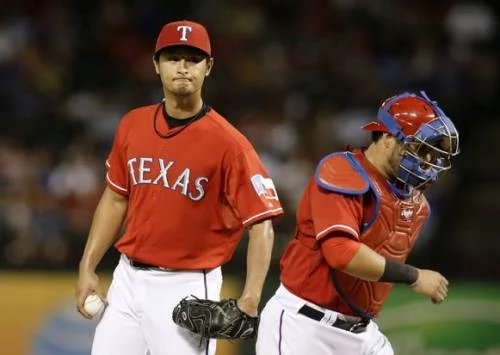
I’m sure after last night’s start, Yu Darvish, were he to have his way, would go through the clubhouse and kick every hitter in the lineup right in the shin. It’s gotten that bad.

Nevermind the fact that the offense has been struggling to put much of anything on board to begin with, but the trend of failing to put runs on the board in games that Darvish starts continued last night as the Rangers were shut out at home against Pittsburgh by a score of 1-0.

Good teams don’t waste starts by their best pitcher. It’s the biggest difference between Felix Hernandez (12-9 record) and Max Scherzer (19-3 record). The Tigers are a team that scores for their best pitcher this season, and the Seattle Mariners are, well, the Seattle Mariners. And in that, you see the only way pitching W-L records matter at all. They’re almost always a reflection of how well a team plays when a specific pitcher starts. Yu Darvish is now 12-8, and for a club that fancies itself a contender, it’s an unacceptable reality that it has massively failed its best pitcher.

If we sit here and imagine that record being something closer to 16-4 or even 15-5, suddenly we’re talking about a team that, despite the offensive struggles of the past week and change, still finds itself at the top of the AL West.

What doesn’t help is that Adrian Beltre is in freefall mode right now. He’ll get hot again at some point, but for now, he’s been ineffective as of late. Ian Kinsler hasn’t been any better. He has 7 hits in the month of September. Even worse, he’s failed to draw even a walk since August 24 against the White Sox. Two guys that have been expected to contribute have been perhaps the coldest on the team, and that needs to change for this club to turn things around.

There’s an argument to be made that both could use a day off. Kinsler has yet to have a day off since returning from the DL on June 15. Beltre has been similarly used, as he’s played in 141 of 143 games, missing only two games at the beginning of June due to a nagging hamstring that has hampered his running ability (and at times, his defense) for much of the season.

Maybe Kinsler and Beltre are gassed and could use a day off. Beyond that, the two of them just need to get on a streak.

Or maybe I’m wrong, and this whole thing is doomed anyways. But I don’t think I’m wrong. I don’t think.

The Law of Selig

This part of the baseball calendar is always a potential boring and a dry time as far as writing goes. I had originally intended to write a piece on how the MLB could make All-Star week more exciting (like adding a skills challenge of sorts). Alas, it didn’t happen, and for two reasons: One, I couldn’t think of enough decent and tangible ideas, and two, I came across some more of Bud Selig’s rambling nonsense.

Although he has a contract that expires after 2014 and there are rumors that he’ll step down at that time as the commissioner of baseball, there has been no real effort on his part to identify a replacement. While we allow our country’s president to act in 4-year terms, the man responsible for overseeing our national pastime is allowed to operate indefinitely in a position he’s held, effectively, since 1992. He’s done some good things for the sport (like adding a wild card), and he’s done some bad things as well (like the whole PED era or not fixing the error that should have been Armando Galarraga’s perfect game).

This week, the big headline as it related to Selig was his statement that baseball is somehow cleaner than it’s ever been, which is ironic in that the big news in baseball all year has been the looming potential for the biggest sweeping PED scandal to result in so many major suspensions since Major League Baseball adopted its various testing programs.

The kicker, however, if you ask me, is Selig now showing concern over the attendance issues that plague the Tampa Bay Rays.

It is beyond disappointing. You can not ask a franchise to continue, when they have been so competitive and really, really done a marvelous job, in a situation that is economically not tolerable.

What isn’t tolerable is the fact that Selig is either ignorant, or he’s just facetious in his attempts to deflect from the real problem with baseball in Florida: The Miami Marlins.

For all the concern surrounding attendance for the Rays, it baffles me how the man who is supposed to have the best interest of baseball continually ignores what is effectively the worst situation I can remember plaguing professional sports. It’s the Marlins, not the Rays, that are dead last in baseball in average attendance. Part of the issue with the Rays is that Tropicana Field isn’t ideally located, and attempts to secure a new stadium have, thus far, failed. In Miami, that excuse doesn’t exist. The Marlins were able to swindle taxpayers into paying for a shiny new stadium, and the promise to compeat was all Marlins owner Jeffrey Loria had to give in exchange. It was a promise, as it turns out, the proved to last only long enough to get the stadium open.

For years, Loria has been scheming and profiting from a situation Selig handed to him. It was Selig that helped Loria get the Expos out of Montreal, forcing the team to play “home” games in Puerto Rico in an effort to dodge a stadium agreement that hinged on attendance. If that wasn’t bad enough, the Expos were disallowed September call-ups in 2003, crippling them competitively. During that time, MLB bought the Expos from Loria for $120 million in 2002, which he turned around and used (plus an interest free loan from MLB of $38.5 million) to purchase the Marlins.

The Marlins “accidentally” won the World Series in 2003, setting off a chain of events that has yet to offend Selig enough to force him to take action. He allowed Loria to sell off any players with significant contracts, and the vicious cycle began. The problem was, Selig and Loria knew that there had to be what looked like an effort to win with a new stadium on the horizon. Loria signed some big names to big contracts, hired the most controversial mangaer in baseball, and things were off as Marlins Park opened in 2012. By the trade deadline, Loria was already selling off pieces, and if it wasn’t before, it was plainly obvious once the offseason hit that the Marlins have no intention of competing. He shipped off Jose Reyes, Mark Buehrle, Josh Johnson, John Buck, and Emilio Bonifacio for some warm bodies.

The one “star” that the Marlins do have, Giancarlo Stanton, doesn’t have enough service time to make the big bucks yet, so he’s forced to sit and wait for his turn to walk out of the revolving door in Miami. After opening the season with a $101.6 million payroll in 2012, they opened this season with a figure much less than that, at about $36 million.

But yeah, Selig’s attention is still in Tampa, where he’ll surely try to work some under-the-table deals to rectify a situation he shouldn’t have control over. All the while, a situation he should have control over continues to get worse about 265 miles to the southeast continues to deteriorate, as Loria and the Marlins pocket revenue-sharing dollars that were meant to help poor teams pay for talent. Instead, the Marlins claim they’re losing money, pocket money from richer teams like the Yankees and Red Sox, and leave taxpayers with the $2.4 billion bill (a stadium deal which is currently the subject of an SEC investigation) for a stadium the team never deserved in the first place.

Like many, I’m counting down the days until Selig finally realizes that this sport doesn’t need him anymore. We have the Marlins problems, the issue of instant replay, and none of this even mentions how he’s managed to keep the Oakland A’s — a team that actually competes — from earning a new stadium themselves. Despite all of that, it’s more important to Selig to claim that his game is “clean” and worry about the attendance of one franchise without addressing the very fixable attendance issues of two others. I knew this happened in life, but in baseball, the good-old-boy system is in full effect. The Law of Selig can’t be touched, modified, or tampered with. The only hope is if the end of 2014 finds baseball with a new commissioner.
Solving Problems From Within

The scenario that entices me most, however, is the one in which Martin is the everyday center fielder in 2013. He’s got the higher ceiling, has the tools to make it work, and I feel like he should be given a chance to become a mainstay in Texas. It’s not likely he’ll be able to come close to replacing Hamilton’s production, but his overall makeup is one of a player that can be a difference-maker for a team that hopes to remain in playoff contention for years to come.

The above was something I wrote on January 14 of this year. It’s something I’ve felt for a long time, well before Josh Hamilton dropped a fly ball and became a punching bag for why MLB free agency is a high-risk proposition. Last season, I begged Ron Washington (as if he could hear me) to give Martin a chance over players that the manager was more comfortable with, such as Craig Gentry and David Murphy. I felt that, if Hamilton moved over to left field, Martin could slide into center seamlessly, take his lumps, and grow into the player the front office felt they were getting when they signed him to a 5-year, $15.5 million deal in 2011.

As of this writing, Leonys Martin is on the hottest streak of his career. He carries an 11-game hitting streak into today’s series finale against the New York Yankees, and he’s proving to be one of the more consistent hitters in the Rangers lineup. Heading into the offseason, much talk was about how the Rangers needed to find a free agent replacement for Josh Hamilton in center field, that an everyday center fielder didn’t currently exist on the roster. Both Martin and Craig Gentry played well in Spring Training, and thus were used in a platoon situation to start the season. While Martin was slightly better with the bat, neither player was able to seize control in the early going. Then it happened. Ron Washington finally decided to trust one of his young players:

It’s been his job for about 15 games. Neither one of them (Martin or Gentry) was pulling his weight with it, and then he (Martin) did.

While Craig Gentry recently went on the DL with a broken hand, Martin had been receiving consistent starts before that, and with Gentry out until at least the All-Star break, now is the time for Martin to prove that his manager made the right decision.

So far this season, Martin has put up a line of .288/.339/.452 for and OPS of .791 and a wRC+ of 110. Possibly more importantly, Martin has been a force on the basepaths with 13 stolen bases, fitting right into the aggressive style that Ron Washington loves to employ.

According to the Baseball-Reference definition of high-leverage situations, Martin has an OPS of .845, and .950 in medium-leverage situations. He’s coming through in times when the team needs him most, and his two-homer game against the Yankees on Tuesday was only the latest example of how well Martin has been helping to drive an offense that is finally starting to come out of an almost month-long funk at the plate. The more time he plays in the outfield, the better his defense gets, and that can only mean good things moving forward.

With all of that said, it’s now up to Martin to prove he belongs, and to reward his manager’s faith. Last season, Craig Gentry had a hot streak of his own, yet was unseated when Washington elected to give David Murphy more at-bats against left-handed pitchers. I don’t believe such a veteran player exists on the roster this season that Washington would feel comfortable taking a chance on. This is Martin’s time to shine. He’s been let out of his cage, and while I fully believe he can excel, he has to deliver on the promise of his talent.

Will the Real Yu Darvish Please Stand Up?

I’m back.

The unfortunate part about being a fan of the San Antonio Spurs is that, on an annual basis, the team is in the NBA playoffs. Then you have seasons like this year, where you have a feeling that something special could happen, and it makes it difficult to fully focus on baseball. While the NBA Finals didn’t end the way I would have liked (I swear Game 6 scenarios must hate me), I’m still immensely proud of what the Spurs accomplished this season by pushing Miami to a Game 7 and having the championship still in question even within the final minute.

Nonetheless, even though I haven’t been able to devote my full attention to baseball, I’ve still watched the Rangers and followed everything going on with the club. After last night’s 4-3 walk-off loss to the Yankees, I found myself asking, “What’s happening to Yu Darvish?”

So far this season, it’s been a tale of two pitchers. While Darvish hasn’t been bad by any stretch, he’s gone from dominant to start the season to just good in recent weeks. Following a May 5 win against the Boston Red Sox, Ron Washington had this to say about Darvish:

“He’s a No. 1 pitcher. He just had to get his foot on the ground in the United States. He has pitches, and, because he can throw anything at any time for a strike, it makes him tough.”

Since that time, Darvish has gradually moved away from what made him so effective early in the season.

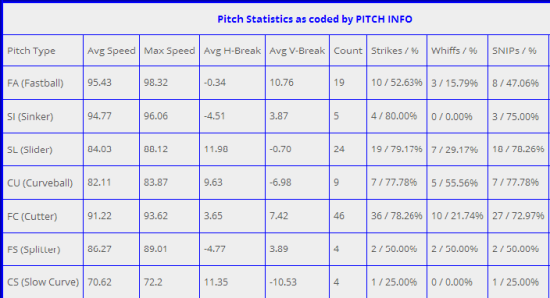
The chart above shows the pitch statistics for Darvish’s April 2 start in Houston; the near-perfect game. On that night, Darvish had his entire repertoire of pitches working for him, throwing 79 of his 111 pitches for strikes and only allowing one baserunner on a Marwin Gonzalez hit with 2 outs in the bottom of the 9th inning. He worked primarily wit his cutter and fastball, used his slider as a strikeout pitch, and threw in the occasional curveball to keep hitters off-balance. He recorded 27 whiffs (swing-and-misses), 58 SNIPs (strikes not in play), 14 strikeouts, and no walks. Fast forward to last night and the results look a little different:

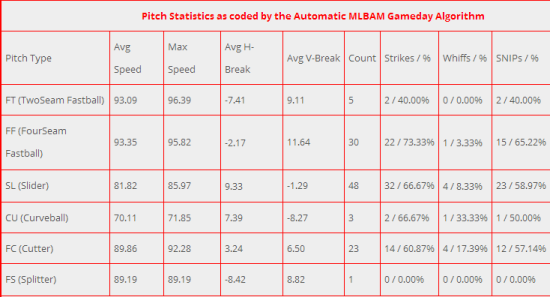
Last night in New York against the Yankees, Darvish only lasted 5.1 innings with 7 hits and 2 walks. While still throwing 72 of his 110 pitches for strikes, he only amassed 10 whiffs and 52 SNIPs. Overall, those numbers aren’t alarming, and while the Yankees managed more hits and walks than the Astros did on April 2, the strikes are still there on the whole. So what’s different?

The obvious answer is home runs. Darvish gave up 3 of them last night, the only 3 runs he surrendered. He’s always going to be prone to issuing walks with the type of pitcher he is, so that isn’t so much an item of concern. The difference lies in pitch selection. The dominance Yu Darvish displayed to begin the season started with his fastball and ended with the slider. Looking at the second chart, it’s easy to see that the slider has become the primary go-to pitch for Darvish, and hitters are no longer swinging and missing on as many of them. At the same time, Darvish has moved away from using his fastball, and his fastest offering last night sat almost 2 mph lower than what he was able to reach back for on April 2.

Darvish has seemingly lost confidence in throwing his fastball for strikes, something that can sometimes be easily identifiable by watching him pitch. He’s no longer getting ahead of hitters early and forcing them to swing at the slider or helplessly watch it catch the outer corner of the strike zone. Instead, hitters are sitting on the breaking ball and simply waiting for it up in the zone. Of the 3 home runs the Yankees hit on Darvish, 2 were on sliders. The other? a 68 mph curveball.

Now, while I do find the fact that Darvish has regressed to old habits from when he first started in the Major Leagues, he made adjustments last year to finish the season stronger than arguably any other pitcher in baseball. I think he can do the same here. Right now, it just becomes a matter of Darvish not allowing himself to become discouraged and revert to bad habits if he doesn’t have his fastball in the early-going of games. By no means has he been bad, but for a pitcher that has shown he can be one of, if not the most dominant pitcher in the game, simply good just isn’t good enough.

Mike Maddux, it’s your move.

View from the Bench: Tuesday Morning Notes

Some news and opinion out there this morning:

  • Ken Sherrington addresses Josh Hamilton’s comments, as well as Hamilton’s attempt to clarify what he meant, which probably sounded a lot worse than his initial comments.
  • Richard Durrett talks about the progress of Alexi Ogando’s changeup, which Ogando will test out against live hitters in the first intrasquad game of the season today.
  • Durrett also has a nice write-up on Derek Holland and Matt Harrison, pointing out that Harrison looks to be the safer bet for a consistent season, while Holland has the higher upside.
  • Ken Rosenthal has a column on one of my favorite guys to watch: Adrian Beltre. Among other things, he points out that Beltre doesn’t get nearly the attention he deserves.