Skip to content

Home

The Rangers Are 38-24

The Rangers just won a game they probably had no business winning.

  • Colby Lewis, in typical 2016 fashion, was beyond solid on the night. He went a full eight innings, only allowed three hits, no walks, and just one run on a solo home run. At 88 pitches, Colby probably could have come back out for the 9th inning. He was that good. His pitcher game score was 75. Pretty good stuff.
     
  • Going into the top of the ninth inning, and down 1-0, the general consensus on Twitter seemed to be that folks wanted anyone but Prince Fielder up with the game on the line. Alas, Fielder ended up coming to the plate with two outs, and down to his final strike, hit possibly the hardest ball I’ve seen him hit in a Rangers uniform. It was crushed.
     
  • Of course, that came after I tweeted out that Fielder looked mostly awful and wasn’t showing any signs of turning his season around. He finished the night 3-for-5, so for a day, I look silly. By no means does it mean his season is back on track, but for a night, he put the Rangers in position to steal a game they had no business winning.
     
  • This game ended up going eleven innings, and in the top half, Rougned Odor led it off with a home run that was crushed to straightaway center field. That gave Texas the final 2-1 margin.
     
  • Ian Desmond had a fantastic game in center field. He was all over the field, making plays, none bigger than a ball Robinson Cano hit to shallow center field while Desmond was playing deep. Desmond charged it, made the sliding catch, and that quite possibly kept the tying run from scoring.
     
  • This is the type of game that felt weird. If the Rangers hadn’t tied it in the ninth and went on to lose, hey, at least Colby saved the bullpen. However, once it went eleven innings, it was the type of game that feels great to win and demoralizing to lose — at least from a fan perspective. So, suffice to say, the Mariners probably aren’t feeling too great about letting this one slip away.
     
  • Rubber match tomorrow with Cole Hamels on the mound at 3:10 PM for your American League best Texas Rangers.

The Rangers Are 37-24

That game probably irritated me more than it should have.

  • Derek Holland got his turn to pitch against the Mariners again, and after a fantastic outing last Sunday, he wasn’t nearly as sharp. He allowed 5 runs in 5.0 innings on 5 hits and 2 walks while giving up 3 home runs. On the season, Derek’s ERA is now 4.87 with an FIP of 4.80. His xFIP is 5.38. With a K/9 of 5.01 and BB/9 of 2.78, there’s just not much room for error. A fantastic defense has been able to bail him out many times, but when he’s giving up home runs, there’s not much the defense can do. Overall, it’s been a disappointing season for Holland.
     
  • Each of the Rangers first three hitters — Jurickson Profar, Ian Desmond, and Nomar Mazara — in the lineup had 2-hit nights, as well as Mitch Moreland. Desmond had a home run and Moreland hit two home runs himself. The only other run-scoring play was Ryan Rua‘s solo home run. The offense was probably good enough to win, but pitching and defense killed the Rangers.
     
  • I found myself once again confused by Jeff Banister‘s bullpen management. While he’s become known as a guy his players love, it’s become clear that he’s lacking severely in the bullpen usage department. Tom Wilhelmsen came in to work the sixth and seventh innings, which made sense with the Rangers down 5-1 and 5-3 prior to each of those innings. However, by the time the Rangers came to bat in the eighth, it was a 5-4 game, and Banister elected to turn the ball over to Shawn Tolleson.
     
  • Tolleson, for his part, looked exactly like a guy dealing with personal issues will sometimes look. His pitching, on its own, actually wasn’t terrible, but everything he did between pitches was awful. He led off the inning with a strikeout of Nelson Cruz, but a wild pitch allowed Cruz to reach safely. When Dae-Ho Lee followed it up with a tailor-made double-play ball, Tolleson bobbled it momentarily, giving him only the play at first and moving Cruz over to second. At that point, Banister elected to have Tolleson intentionally walk Kyle Seager.
     
  • Chris Iannetta singled to left fielder Ryan Rua, who came up throwing. Inexplicably, Tolleson decided to stand somewhere between third base, the mound, and home plate instead of backing up Robinson Chirinos behind the plate. In an attempt to cut off Rua’s throw, the ball bounced off of Tolleson and allowed Cruz to score and moved Seager to third.
     
  • As if that weren’t enough, Seth Smith hit a sacrifice fly to Ian Desmond in center field, and once again, Tolleson was sort of just roaming around in the infield instead of backing up Chirinos, allowing Iannetta to move over to third.
     
  • In the ninth, Mitch Moreland’s second home run of the game gave Texas their fifth run. Of course, had Banister elected to use one of his better relievers in a one-run game, perhaps the home run would have tied the game. Alas, it only made the final margin of 7-5 just a little less painful.
     
  • At the very least, it’s fairly safe to assume that Jeff Banister’s theory on bullpen usage involves something to the effect of, “We’ll use our good relievers with a lead, no matter how large. For every other situation, we’ll turn to the other guys.” While that sometimes works out (see Wilhelmsen’s usage in what wasn’t exactly a close game at the time), you’d like to see less hard-riding of guys like Sam Dyson with a five-run advantage while also having them available in close games when you can perhaps count on the offense to score one or two additional runs.
     
  • They’ll do it all again tomorrow, with Colby Lewis on the mound.

Profar, So Good

13 games as the leadoff hitter.  

.389 average. .400 OBP.  21 hits.  12 runs.  13 game hit streak.  9 multi-hit games.

So far, so good.

Welcome back to the bigs, Jurickson Profar.

After a much publicized two full seasons away from MLB due to a shoulder injury, Jurickson Profar is back and living up to the expectations he once carried as the top prospect in all of baseball, which, until two weeks ago, felt like a distant memory.  

If he keeps up his current pace, or anything close to it, then the wait will have been well worth it.  

In his first stint with the Texas Rangers, Ron Washington attempted to utilize Profar as a super utility player, moving him all around the infield and getting him some playing time in left field.  The constant position changing proved to be too much for the then twenty year old, and he scuffled at the plate, hitting only .234 in in 324 plate appearances in 2013.  Profar often looked lost at the plate and began to appear discouraged as the struggles of being an everyday Major League player began to set in.

Those looks of discouragement are long gone, replaced by an electric smile that leaves no doubt that the kid is having fun, that he belongs, and that he is here to stay.

The question is; how does he stay?  How does Profar remain an everyday player and how does Banister work him into the lineup?  Upon his call up, the answer was easy with Profar playing second base while Odor was suspended.  Currently, Profar will be slotted in at third base through the weekend while Adrian Beltre is nursing a sore hamstring (side note, I would not at all be opposed to the Rangers going ahead and putting Adrian on the shelf for 15 days.  This is a long season and I would much rather rest him now to make sure he is fully healthy later in the year, because October could be very important for this squad.)

The obvious answer came when the lineup card for the June 7th game in Arlington against the Houston Astros was posted.  For the first time in his career, and after one day of practicing at the position, Jurickson Profar found himself penciled into his newly familiar leadoff spot, but this time, at first base.  He played splendidly, handling the position as if he had been there his entire life, even completing three highlight reel plays (we now know that Profar can do splits).

But preventing this from happening, there are two major road blocks which are normally penciled into the Rangers every day lineup:  Mitch Moreland and Prince Fielder.  The struggles of both have been well documented.  Prince is hitting .193 and has lost all of his power and is working to make changes to his swing to attempt to find some ability to hit for average, eliminating his leg kick for an abbreviated toe tap earlier this week after being “unplugged” from the lineup over the weekend by Banister.  Moreland is hitting .206, and while he does offer a plus glove at first base, Mitch has shown few signs of life at the plate, despite this being his free agent season after many years of being a key piece in many successful Texas Rangers seasons. (Because baseball works in mysterious ways, Moreland hit a ball 442 feet at the exact second I added the period to that last sentence.  I’m leaving it though, just because I will be the happiest guy on the planet if he proves me wrong)

The Rangers need to move on from someone.  At this point, moving Prince looks beyond unlikely, even though other teams who are trying to win this year are setting strong precedents by benching or releasing high paid players, such as Pablo Sandoval in Boston or Carl Crawford in Los Angeles.  I don’t see this happening with Texas and I don’t see anyone taking on Fielder unless Texas pays basically all of his contract, similar to what the Angels did to donate Hamilton’s remains back to the Rangers.  (By the way, remember a month ago when I wanted to attach Profar as a free add on to Fielder to get other teams to bite?  I am a moron).  

A number of people have stated that instead of making a move to open up playing time for Profar, that this moment is the right one to move him while the asking price is climbing back to a high point.  Here is the problem with that though:  he still has not proven that he can play shortstop every day post-shoulder surgery, his value is nowhere near where it was when he was deemed “untouchable” just four years ago, and if the Rangers are making that move, they are saying that they don’t believe that he will ever turn into the player they once thought he could be.  

This leads us to the most logical option: moving on from Mitch Moreland.  As a fan, I have always liked Moreland.  He seems like a great teammate, he has a great glove, he has solid baseball instincts that help with some of his shortcomings.  Mitch has been an important part of a great run, but it may be time to move on.  At this point, I don’t see how the Rangers can rationalize giving Moreland at bats over Profar moving forward (or Gallo, for that matter, but that is a different article for another day).  

Before we get further into this, I fully understand that the return for Moreland on the trade market is going to be basically nothing due to the combination of the lackluster performance this season and the fact his contract status makes him a short-term rental.  However, there are several teams who could use that very thing, with the New York Yankees currently having four first basemen on the disabled list and with the New York Mets grabbing James Loney off of the scrap heap to fill in after Lucas Duda was put on the shelf for the season.  Both of these teams, as well as a few others, could use the services of Mitch for the rest of 2016 and could help the Rangers make moves in order to put the best potential lineup on the field each day.  

As Profar continues to hit, continues to run, continues to field, and continues to smile, he will also continue to put pressure on Banister to find a way to get him into the lineup every single day.  The franchise is currently blessed with more depth than I can ever remember.  

What a wonderful problem Profar presents. 

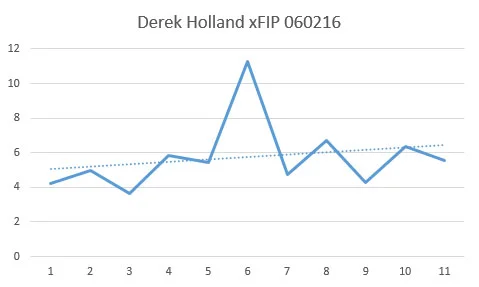
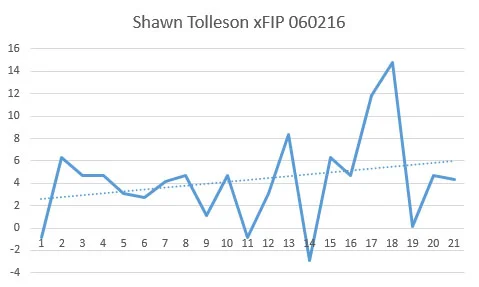
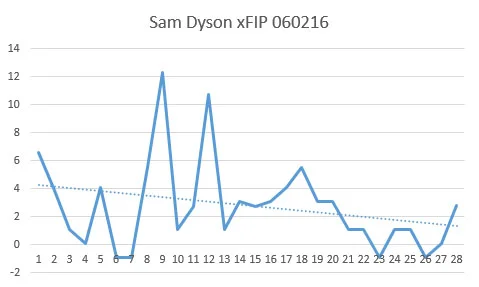
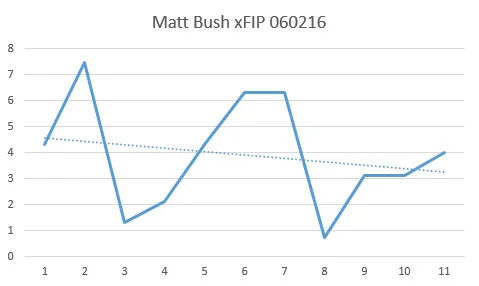
More Trend Analysis: Pitcher xFIP

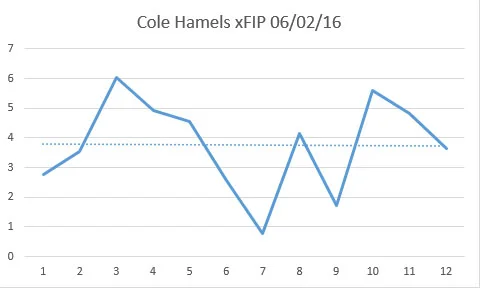
More trend lines!  xFIP, or eXpected Fielding Independent Pitching, is intended to not only take team factors out of a pitcher’s performance (FIP), but also “normalize” home run outcomes by applying a constant to Fly Balls Allowed based on averages.  The stat has a pretty good history of telling you the true talent level of a pitcher once you take most of the variables out.  It also, therefore, does a good job of telling you when a pitcher is legitimately pitching worse or better.

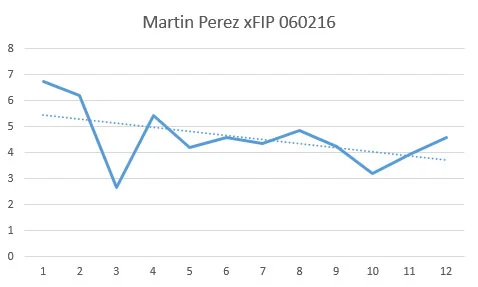
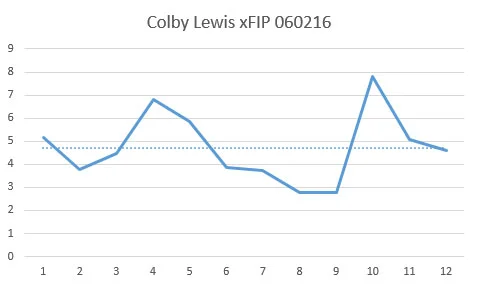
xFIP works like ERA; high is bad.  The trend line follows suit; high side on the right is trending up which is bad, low side on the right is trending down is good.  A flat line indicates stability and is good, as long as the number it represents is good (like, under 4 is groovy).

Cole is, until we have a better understanding of how Darvish is going to play out, the most important member of the roster.  Hamels has been steady, and is legitimately pitching slightly worse this year…but not by much.  He’s been pretty solidly a 3.5 xFIP guy, and as you can see, Cole is sitting around 3.7/3.8 this year.  The trend is good though, so there’s every reason to believe he’ll finish the year in fine form.

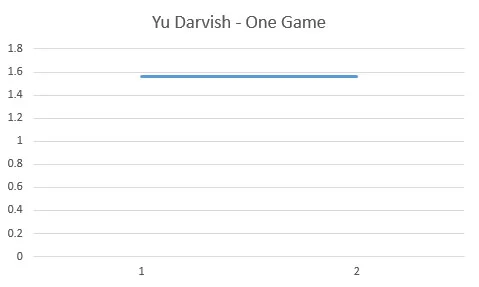
Speaking of Darvish, there obviously isn’t a trend line, but his one game is one of the best starts by a Rangers pitcher this year.  Optimism!

How ’bout Martin Perez?  The trend is right, but that’s as much because of a bad start.  It wouldn’t surprise me to see Martin stabilize right around 4.00; anything under that would thrill me.  And take note that would put him on par with Hamels.

Solid as a rock.  In fact, he was trending down to 4.00 like Perez before his last bad start.  This is probably what Colby looks like all year, and once again puts him in that “#4 starter” territory.

Oh, dear.  The good news is, without the one game, the trend isn’t quite as bad.  But it’s still bad.  Pitchers have managed to outpitch their xFIP for entire seasons.  It’s not unusual.  But it’s not the norm, either.  If/when Holland blows up, it shouldn’t be unexpected.

As with Delino Deshields, we must ask ourselves:  “Was Shawn Tolleson actually performing that poorly?”  As you can see, the bad appearances were getting worse and worse, and he only had a few good appearances.  More importantly to Jeff Banister, I suspect, is that Tolleson wasn’t predictable.

That’s what you like seeing in a closer.  At least the recent results.  Since being made the closer, Dyson has been exceptional.  Remember that big uptick at the end is the average, which I include to “normalize” the line a bit.

Matt Bush’s trendline is good, but I’m not too thrilled that it’s centered on 4.00.  And of course, as has been a frequent topic of discussion, there are other factors to consider with Bush’s quality of pitching. 

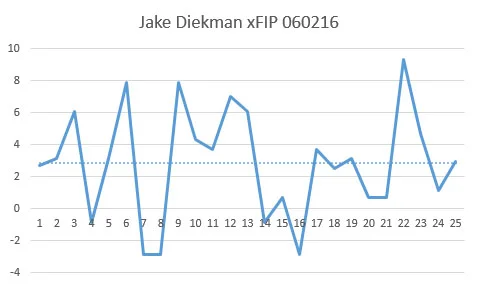
Jake has been very off-and-on this year which makes his 2.5 xFIP stable trendline somewhat misleading.  He’s still the second-best reliever behind Dyson.

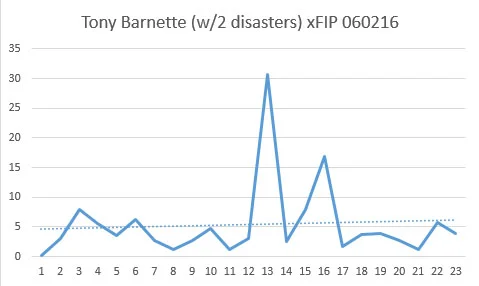
Here’s Tony Barnette with two really bad appearances.

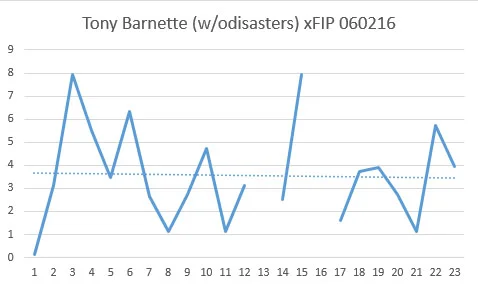
Here’s Tony Barnette without the two disaster appearances.  More stability would be nice, but trending from 4.00 to 3.00 is a decent indicator that he can keep filling in reliably.

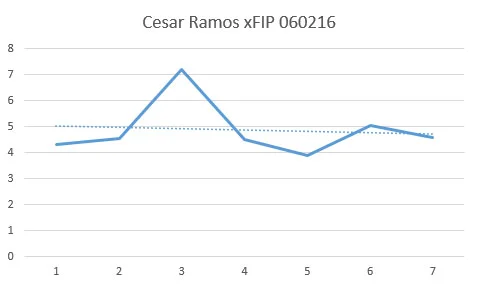
This is both starting and relieving.  It’s about as good as it gets in a spot-starter/long-reliever.

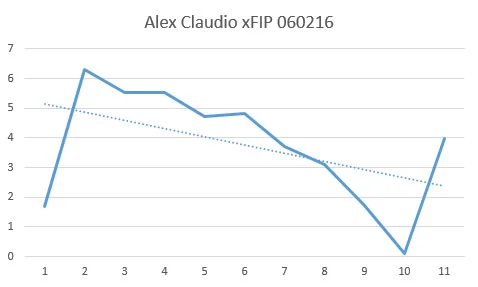
I almost forgot about Alex Claudio, and it looks like that would have been a mistake.  Not only is better at his worst than some of the other relievers, he’s steadily improved.  Again, remember that last big uptick is the average.  I would bank on Claudio getting a lot more time, soon.

There is still a good core group of relievers here.  Looking at the performance histories and trends, I’m seeing consistency as a bigger problem than actual ability.  Consistency can be a function of the pitcher of course, but it can also be a function of the catcher; a position that has been highly unstable for Texas this year.  It can also be a problem with game planning, and Banister is working with two new coaches this year as well.

Taking all of that in, I’m still a lot more worried about injuries and arm fatigue than I am who’s on the roster.  As the roster itself stabilizes, I think the relief corps will, as well.

Joey Gallo Can’t Buy Playing Time

Joey Gallo, recalled on Monday by the Texas Rangers, is still on the active roster. He’s logged a grand total of… one plate appearance.

Now, there was at least some expectation that when Gallo was brought up earlier in the week, it was only temporary. That when Jurickson Profar was inevitably brought up to fill in during Rougned Odor‘s suspension, Gallo would go back down. And yet, Shawn Tolleson‘s family emergency allowed for Profar to slide right up without necessitating any other moves.

There’s a fairly decent chance that Gallo goes back down to Triple-A later today to make room for Yu Darvish, and yet, I can’t seem to get a sour taste out of my mouth.

During last night’s drubbing at the hands of the Pittsburgh Pirates, Joey Gallo couldn’t get even one plate appearance. While Prince Fielder and Mitch Moreland — both lefties like Gallo, mind you — continue to be among the worst hitters in the game, it seems to have never occurred to anyone in the Rangers clubhouse to get Gallo into the game.

Now, this isn’t just about a player losing five days of plate appearances. In this case, it’s a player who, for starters, doesn’t have a defined position for which the Rangers will end up seeing him play. He’s very clearly blocked at third base by Adrian Beltre, so it would behoove the Rangers to find out exactly what they plan to do with him.

Furthermore, Gallo had just missed three weeks on the minor league disabled list with a groin injury.

To recap, we have a player who has no defined position, who has now missed the better part of a month in what very well be the most important season for him developmentally, and who probably needs at-bats more than any other player in the Rangers system. And he’s sitting on the Major League bench.

I can’t make sense of it. Maybe there’s no sense to be made of it. But it’s going to be incredibly frustrating if, to start the 2017 season, Joey Gallo needs another stint in Round Rock because he’s “not quite ready yet”, and we’re able to point at a few days in May and wonder what the hell the Rangers were thinking.

Because if I’m being honest, they can’t be thinking. It’s inexplicable, and you can’t convince me that the team wouldn’t be better served by at least seeing if he can perform better than Fielder/Moreland while he is on the active roster.

Of course, as it turns out, they may have wasted that chance. It was deemed more important that he sit on the bench and watch instead of calling up another bullpen arm so that maybe Matt Bush doesn’t need to pitch three days in a row for the first time ever — and after not doing anything with a baseball for four years — and Sam Dyson doesn’t need to add on to his alarmingly high number of appearances in a 6-run blowout in favor of the Rangers.

I’m not a Major League manager but, well, a lot of things aren’t making a hell of a lot of sense these days, and I just wonder how much longer it can continue before Jeff Banister‘s tactics and the Rangers run-differential finally come together to show that, yes, the Texas Rangers have been overachieving thus far in 2016.

Oh, and happy Yuesday.