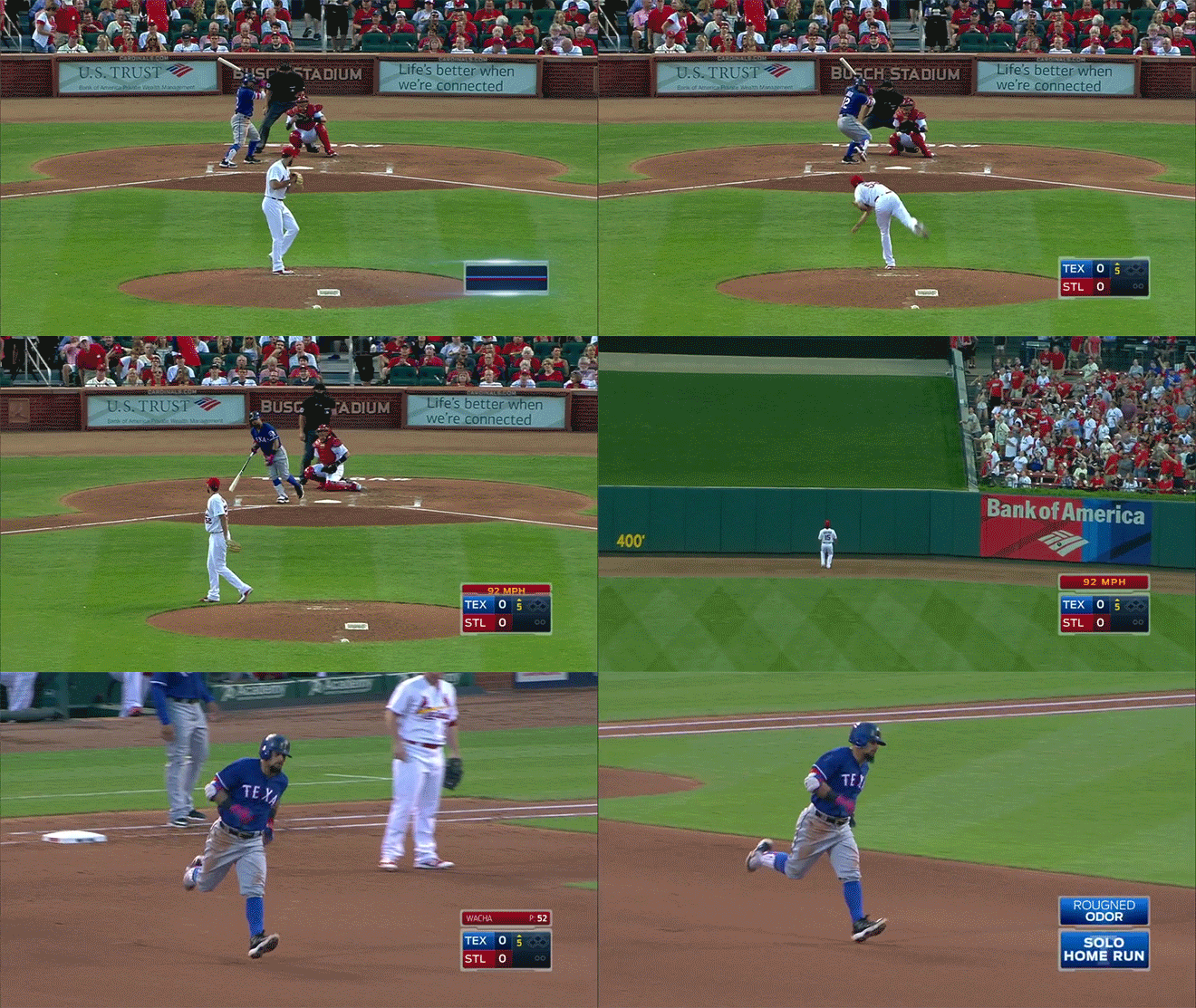
The Rangers are now 4 games up for the best record in the American League, and on pace to win 102 games. If you’re not entertained, baseball probably isn’t for you.

The Rangers are now 4 games up for the best record in the American League, and on pace to win 102 games. If you’re not entertained, baseball probably isn’t for you.
Winning baseball is fun, no? The Rangers are 42-25, continuing to break records for Best Start in Franchise History.
On pace for better than 101 wins.
Ten straight series wins (Franchise Record). Before this series, remember they beat the old franchise record for home series winning streak.
2nd place in the AL West is Seattle at 6.5 back. Nobody else in the division is within single digits.
3 games up on everyone else in the League.
Only one team in all of baseball (Cubs) has a better record. Only one other team matches them (Nationals).
Colby Lewis has been so good this year. (HOW GOOD IS HE?!):
We’re over 40% of the way through the season. I think it’s safe to start getting excited. Enjoy what we’re watching. Rangers fans are getting to see a whole lot of new this year. I’m starting to think fans have a good chance of seeing something else new come October.
And that’s why baseball is the best sport.
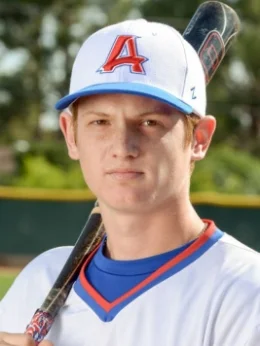
Sam Huff was the first catcher the Rangers drafted in the 2016 MLB First-Year Player Draft
The Texas Rangers franchise hasn’t always been this good. In the 1970’s they were particularly terrible, as most low-budget teams were. Mike Shropshire wrote a book about the beginning of our beloved Texas Rangers Organization, called Seasons in Hell. In it he discussed the birth of a team and a fan base that would suffer terribly for at least two decades. If you have not read this book, I encourage you to read it. It is the rated-R version of Major League, only more depressing than funny. To quote one of my favorite lines from the book, manager Whitey Herzog discussed the catching situation in Arlington before the 1973 season:
“If Rich Billings is the starting catcher again, we’re in deep trouble.” When that evaluation was passed along to Billings, he simply nodded and said, “Whitey obviously has seen me play”. But Whitey, obviously, had not seen the other candidates for that position play, and now Billings was again penciled in as the starting catcher.
The teams of the 1970’s and 1980’s were pretty terrible. In fact, it would be comical if it weren’t so depressing. To state the obvious, this team is nowhere near that bad. Your Texas Rangers are 40-25 and hold the best record in the American league. To say that I am surprised is an understatement. I thought that this team would be good, but had no idea that they would be this good. There are young players and new additions (think Ian Desmond) contributing to the success of the team and it’s exciting. It is hard to point out the flaws on this team but nonetheless, there are some. I believe the Rangers’ biggest long-term problem is behind the plate.
The Rangers do not have a long-term solution at catcher. This is fact. Robinson Chirinos is 32, Bobby Wilson is 33, and Bryan Holaday is 28. All of these guys have done the job behind the plate. I wouldn’t say that they have done great, but they have played the position. However, none of these players are a franchise catcher. The young man who I believed was going to be the mainstay behind the plate for the next decade was traded to the Phillies. I’m fine with that; the Rangers received another number one starter and it has made them a contender. However, as we look forward to the Rangers being contenders for the next few years, we cannot forget how they got to this point: One of the best farm systems in baseball.
The Rangers drafted four catchers in this year’s draft. The first catcher they drafted in the seventh round with the 219th overall pick was a young man named Sam Huff, out of Arcadia H.S., Phoenix, Arizona. Huff has a “major league body” at 6’4 and 218 pounds and according to scouts is a “baseball rat”. It is also stated that he has an above-average arm and will likely fill out more. While this is great to hear and the young man has the stats to back up what scouts are saying, there is no way to know what his true ceiling may be. It is also worth noting that he has a scholarship to play with Grand Central University. Whether or not the young man signs with the Rangers, time (and possibly money) will tell.
The second catcher was drafted in the 12th round with the 369th overall pick, University of Pittsburgh senior Alex Kowalcyzk. Kowalcyzk hit .315, 9 HR, and 45 RBI, and that tells us very little. Good luck finding a scouting report on the guy. I went so far as to subscribe to Perfect Game and it offered little in the way of a scouting report. My assumption is that he will either sign or give up on baseball.
The third catcher the Rangers selected in the 2016 player draft was Bethune-Cookman College Junior Clayton Middleton. He was selected in the 22nd round with the 669th overall pick. I cannot find a credible scouting report for him either. His counting stats aren’t that impressive: .226 AVG, 0 HR, 17 RBI in 45 games, 44 of the games he started. I have heard it said that the late rounds are when the scouts begin “throwing darts”. This seems to be the case here. However, there aren’t any scouting reports for this young man, so I cannot speak to his play defensively. I would guess that he plays his senior year in college.
Finally, with the 1209th pick in the 40th round of the 2016 draft, the Rangers drafted freshman Brent Burgess out of Spartanburg Methodist College. He started 62 games, hit .280, 9 HR, and 32 RBI. His fielding pct. was .894, and he committed 25 errors. This kid has some growing to do and I would not be surprised to see him continue his college career.
I present this information with the thought process that we aren’t likely to find a franchise catcher anytime soon. However, there are other options, such as the international free agent market and of course the trade market. While I suppose a trade is possible, I shudder to think what the Rangers would have to give up acquiring someone like Milwaukee’s Jonathan Lucroy. I am sure it would include names like: Gallo, Profar, and Brinson. Frankly, I wouldn’t like that at all. I also understand that Josh Morgan (according to Baseball Prospectus) was supposed to be trying his hand at catcher. However, after looking at his stats on Baseball Reference, I saw that he has not started a single game at catcher for the High-Desert Mavericks. I do not think that the solution is in the organization right now.
I am a spoiled fan in the sense that I remember when Ivan “Pudge” Rodriguez was behind the plate for the Rangers. I realize now, as an adult, that I was witnessing greatness. Pudge could hit, call the game, throw out base runners (from the crouch, no-less), and was an excellent pitch-framer. As a kid I did not realize how rare any of this was. I, like many of you I am sure, took him for granted. The Rangers had a Hall of Fame catcher behind the plate for 11 years, and it was awesome. Here’s hoping that the scouts find another great catcher soon, and we can stop the revolving door behind the plate.
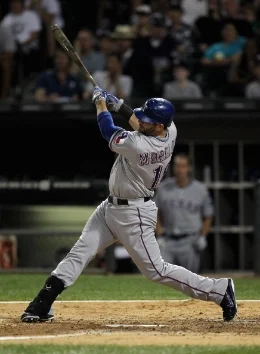
Despite last night’s drubbing at the hands of the Oakland A’s, the Texas Rangers still boast the American League’s best record. That feat is more amazing when you consider that, for almost every one of those games, the Rangers have had two of the worst everyday players in the major leagues in their lineup on a consistent basis.
More specifically, Prince Fielder has been the worst player by fWAR at -1.4, with Mitch Moreland as the 24th-worst with an fWAR of 0.0. Fielder’s case is made even worse by his providing no defensive value, even negative value on the occasion that he actually plays first base. By wOBA alone, Fielder is still in the bottom-five category.
In other words, it’s probably something of a minor miracle that the Rangers have ended up where they are with those two scuffling so badly while the organization waits (hopes?) for them to get things turned around.
I’ve made my stance on Fielder previously known. He looks like a player that’s done. The bat speed is gone, and he’s chasing out of the strike zone at a career rate. I’m of the opinion that at some point, he’ll get the Pablo Sandoval treatment; that is, the Rangers have a good amount of talent, and there comes a point in which Fielder’s contract is a sunk cost.
Moreland, on the other hand, is a different animal. While I’m not necessarily a fan of him getting starts against left-handed pitching, he has the opportunity to at least provide some value. I’ve never been as high on Mitch’s “potential” or “ceiling” as some have been, but at $5.7 million, you could certainly do worse.
He provides some pop from the left side of plate, and had a career year last season in which he was worth 2.1 fWAR. The problem? He’s put up a wOBA of .320. While not as bad as Fielder’s wOBA of .265, it’s still not exactly good. So, what’s the problem? How does a player have a career year and not manage to make solid contact the next?
Well, for starters, Moreland finds himself swinging at more pitches this season then at any point in his career. On both pitches inside and outside the strike zone, he’s swinging about three percent more often. As far as contact goes, his contact rate outside the zone is about in line with recent seasons, but his contact rate in the strike zone is down 3.3% from last season and is 4.2% lower than his career average: An average that is ticked down even more due to his contact struggles this season.
Note: As I write this, Moreland just hit a blast, but these points still remain. It also gave me another GIF to work with, so way to go, Mitch.
Mitch Moreland has always been something of a streaky hitter, but in 2016, those streaks seem to be easily identifiable by what’s going on with his swing. For starters, here are some examples of his swing with home run results on 6/13, 6/12, and 6/10.
So, those all look pretty good. And now, we take a look at some poor swings. The first two are from 6/13 — last night’s game in which he hit a home run — and the last is from 6/9 against the Astros.
In each of those swings, Mitch starts his stride, sets his foot down, and then in the middle of his swing, that front foot pulls back toward the first base dugout.
I say all this with the caveat that I’m not a hitting coach. However, on the surface, a motion that essentially causes Mitch to step away from the plate would seem to take away a significant portion of the strike zone. That might at least partially explain his lower in-zone contact rate in 2016.
The good news is that I’ve noticed fewer of those swings in recent days, which jives well with the five home runs he’s hit over his past five games. I still don’t want him hitting against lefties, but at the very least — and assuming he can get consistently on track — he should be a valuable offensive weapon against right-handers. And if that happens, the Rangers will be better for it.
And while I don’t really hold out much hope that Prince Fielder will get his season turned around, I’m a least slightly optimistic that Mitch Moreland can get his going in the right direction, if he hasn’t already.