
Skip to content

Home

Fine Lines and Dark Circles

For a moment, consider the following sequences:

  1. Single, ground out, single, double, ground out, single.
     
  2. Single, single, line out, walk, walk, grand slam.
     
  3. Home run, strikeout, double, fly out, double, single, fly out.

No, what you’re reading is not the sleep-deprived musings of a maniac that stayed up to watch a West Coast game (On second thought, maybe you are), but the sequences of three of Sam Dyson’s outings thus far in the 2017.

Those three outings, as it turns out, are the major difference between the Texas Rangers being currently 2-5 in the standings and what really could be 5-2. Even if we throw out one of those outings because Texas and Cleveland were tied heading into the ninth inning on Opening Night, that’s still potentially 4-3 at worst, which, only seven games into the season, sounds a lot better in your head.

Yes, I might have dark circles under my eyes from a late extra-inning game, but I’m fully cognizant of the fact that there are some very fine lines between this team being very good and mind-numbingly frustrating.

Fine lines like Sam Dyson not transmogrifying into the second coming of Shawn Tolleson.

Fine lines like Rougned Odor’s hardest-hit ball of the season (110.8 mph) lining straight into the first baseman’s glove or Mike Napoli’s would-be home run to center field getting robbed by Mike Trout.

And even fine lines like the one that decided the fate of last night’s game by allowing Carlos Perez’s squeeze bunt to score Cameron Maybin to remain fair instead of rolling foul.
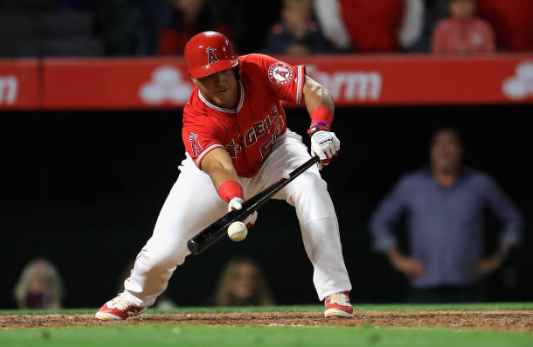
During the course of a 162-game season, these sorts of breaks happen. Build up enough of them and you know what kind of team you have. Things like the bunt or Odor’s line shot? Those things tend to even out.

Your closer going into full meltdown mode? You might want to address that problem before it turns into something much more dire.

The offense? Churning along just fine. Say what you will about the struggles of Carlos Gomez, Jonathan Lucroy, and even Mike Napoli at the plate. If not for blowing a ninth inning lead last night, Texas would have the most runs scored in the American League with 38. As it stands, the four runs the Angels scored vaulted them into the top spot with 41. No matter, the offense is going to be perfectly fine.

For all the hand-wringing coming into the season over the starting rotation, it’s been the bullpen — a purported strength — that has been the weakest link. Yes, Sam Dyson has been mostly awful despite lowering his ERA by three full runs last night. But if you think having Tanner Scheppers out of the mix and Keone Kela on disciplinary leave at Triple-A Round Rock and Matt Bush inexplicably unavailable to pitch after an off day doesn’t make a difference in that picture, then I’m not sure what else to tell you.

Not to be an alarmist, and I’ve seen a few others mention it on Twitter, but from the television side of things, Sam Dyson didn’t exactly look comfortable warming up in the bullpen last night. It could be nothing. Or, given that his max velocity has yet to reach his 2016 levels — even after considering that MLB tracking is 0.7 mph faster on pitches this season than before — perhaps there’s an underlying issue there. Mechanics? Injury? Who knows!

Bush, for his part, is the most concerning. I don’t really want to speculate on the reason for him being unavailable — and Jeff Banister’s non-committal response when asked if he would be available for tonight’s game — other than to say that I hope Banister was simply taking the easy way of implying that the ninth inning was Sam Dyson’s no matter what last night.

So despite all of that, knowing that maybe Tanner Scheppers gets healthy, Keone Kela won’t likely be in baseball timeout for much longer, and that we should have more answers on Matt Bush later today makes me feel a lot better about what has been the major reason for this ball club being unable to lock down games late.

Yes, it looks bad right now. It always does before the dust settles. Fine lines well become more defined as time goes by, and I’m still thinking that this version of the Texas Rangers has enough talent to be competitive and good. 

But really, maybe Sam Dyson shouldn’t be pitching late in games for now.
September 7

You folks know me, by now.  I’m the guy who keeps posting stats and trend lines of stats saying things like Derek Holland isn’t actually a very good pitcher anymore, Tony Barnette is, and Delino Deshields, Jr. shouldn’t be a starting Outfielder.

I also haven’t been shy about saying that I don’t think the Rangers are going to do so great this year, although that was mostly before they made some good moves to bolster the pitching staff down the line.  Other moves I wasn’t too thrilled with, but most of my analysis was based on the idea that, as far as I can tell, the Rangers have been very lucky the last two years.  And luck isn’t quantifiable.

Having said all that…chill out, people.  In the era of Double Wild Card Wildness, which has worked out for MLB beyond their wildest dreams, you can’t eliminate any but the worst teams until well after the All Star break.  Hell, trading away some of your best players before the trade deadline hasn’t kept teams from contending for another six weeks, at least twice now.

All of us want the Rangers to relive 2011, without the oops.  We want Texas to run away and hide like Lewis Hamilton on pole, making the clear statement that the season is theirs to have; at least until the playoffs.

That’s not going to happen.  Even when it *feels* like it happens (the 2012 Rangers were talked about as one of the best teams in baseball history for a while, remember?), it doesn’t *actually* happen.  The most wins in MLB history is still 116, and in the modern era that means your team loses 7 times per month.  That’s a week.  The Rangers would spend A WHOLE WEEK losing baseball games every month, to be tied with the best in history.

That’s a lot of losing.  Or is it?  Perspective is an asshole.

September 7, 2017.  Going into this off day, the Rangers will have played 140 games, if I counted right.  The preceding two weeks of games will have been against the Angels, A’s, Houston, and Atlanta.  That should give them a span of games that will either pad their record, cover some deficiencies, or expose the rotten core.  I think we’ll know on September 7th what the Rangers’ season will look like.

And not a day before.

On Failure, Reality, and Hope

Losses.

We all experience them; in sports, in life, in finances, in relationships.  These losses become a part of us, with our reaction to them defining who we truly are as human beings.

However, some losses are much tougher to bounce back from than others.  Some feel as if they will never stop haunting you.

The emotions that I experienced this Sunday as a Falcons fan are all too familiar to anyone who supports the Texas Rangers.  As the Patriots won the coin toss to start overtime, the resounding thought that crashed through my skull was simply “Game 6”.  My internal screams were deafening.

To this day, I still feel repulsively nauseated every time I see Nelson Cruz misplay that fly ball, whenever I hear the call from Joe Buck, or whenever I even see an image of David Freese.  I imagine the same will go for Tom Brady, James White, or even the explanation of NFL overtime rules (for real though, someone fix those).

Some losses are much tougher to bounce back from than others.  

I have no way of knowing this for sure, but I imagine that those nauseated feelings will remain until either team finally wins it all.  Maybe those losses would be easier if either team had ever won a championship.  Maybe all championship losses suck equally.  I have no idea.   

But I do know this:

Next Tuesday, as pitchers and catchers report to spring training on Valentine’s day, my heart will be full and those pangs of sorrow will once again be pushed away and replaced by youthfully exuberant hope.

That’s one of the most incredible things about sports.

Hope.

At the beginning of every season, we all have it.  It doesn’t matter if you are a fan of the Patriots, Cowboys, or Browns.  The feelings are shared regardless if your closet is lined with gear from the Rangers, Cubs, or Braves.  

The offseason, the new crop of free agents, the buzz surrounded the hot new prospects, the early sales of tickets; it all combines to provide this incredible sense of hope.

I look forward to that feeling, as should all of you.

As the 2016 Texas Rangers season came to an end with that familiar feeling of disappointment, we were all left with so many questions.  Doubt overcame hope.  

The fanbase was told that there was no money for free agents a month after they voted to have their taxes fund a new stadium.  

Fan favorites such as Ian Desmond, Derek Holland, and Mitch Moreland were allowed to walk away.  

Adrian Beltre got a year older.

Joey Gallo struck out again (probably).

Despite all of that, here we are again, with many questions left unanswered, yet slowly filling with hope.

We welcome back the old gang with open arms, as first base becomes a combination of party-incarnate Mike Napoli and new-kneed Josh Hamilton.  We joyfully look forward to full seasons of Yu Darvish and Jonathan Lucroy (and hope ownership mystically finds money to extend them both). We hope Rougie strikes out less and walks more.  We hope Nomar keeps a hot bat for the entire year in his second season.  We hope Gallo recovers from the swinging yips and Profar finds his old form.

We hope.  

Sports, much like life, marks time through disappointment met with new beginnings, only to repeat the cycle again and again, with the joy of victory being so rare that few of us actually know it.

Regardless of how hard things are, how difficult a loss might be, or how long it may take you to recover, every single spring, baseball is there.  So is hope.

I’ll see you next Tuesday.

“Love is the most important thing in the world, but baseball is pretty good, too”- Yogi Berra

Crossroads

Being that it’s the middle of January, we’re at a point in the baseball calendar in which baseball news is virtually non-existent. Other than the terrible news of Yordano Ventura’s unfortunate passing over the weekend, Fan Fest is quite literally the only piece of Rangers relevance out there.

Winter meetings are over, and we’re still weeks away from the beginning of Spring Training. With that comes the annual round of second-guessing. The yearly cries of, “Well, why didn’t the Rangers sign (insert player name here)? Does Jon Daniels just not care? Is ownership cheap?”

For starters, I’m not among those that can so easily tell billionaires how they should spend their money. For me, I understand that baseball is a business, and I’m able to separate that from my fan instincts. Some people can’t, or don’t want to. That’s your right to do so. However, from my perspective, having the 6th-highest payroll in MLB in 2016 is good enough for me.

It’s the season of reactions and overreactions, some more exaggerated than others. So, for an organization that just led the American League in wins, it seems a bit premature to declare the offseason a failure simply because there were no big splashes. And yet, the Rangers find themselves at an organizational crossroads between contending and rebuilding, and the line is finer than you might think.

The first two months or so of the 2017 season will play a part in determining just which direction the organization is headed, but make no mistake that this juncture is only a thing because of a fantastic stretch of winning going back eight full seasons.

Since the beginning of the 2009 season, the Rangers have tallied 707 regular season wins, the 4th-highest total in baseball. That’s including an injury-ravaged roster in 2014 that set records for time on the disabled list and lost 95 games. If we look at all the other seasons compared to the MLB — an exercise in cherry-picked samples, to be sure — suddenly the Rangers are 2nd in baseball during that time, only six wins behind the New York Yankees.

No, none of this has resulted in a World Series title coming to Texas, but neither has it for the Los Angeles Dodgers, a team with 712 wins over this stretch. Winning in the playoffs is hard, and many times requires both talent as well as good fortune. Even the best team in baseball each season figures to lose at least a third of their games. The worst will win a third of theirs. And somewhere in the middle is that final third that determines the difference between the contenders and the also-rans. It’s a game of streaks, and a good or bad streak determines playoff success. It’s not hard to see that baseball wasn’t built for a playoff system.

That the Rangers have managed to be on the positive side of the win totals more often than not in recent years is not only a testament to the talent on the field, but to the front office for putting the organization in a position to succeed. And the reason the Texas Rangers face perhaps their toughest challenge of the Jon Daniels era — deciding to go for it or to go through a slight rebuild — is because of that success.

As a reminder, here are the important trade acquisitions dating back to the 2009 season:

  • 2010 – Texas trades Justin Smoak, Blake Beavan, Josh Leuke, and Matthew Lawson to Seattle for Cliff Lee and Mark Lowe.
  • 2011 – Texas trades Chris Davis and Tommy Hunter to Baltimore for Koji Uehara.
  • 2011 – Texas trades Robbie Erlin and Joe Wieland to San Diego for Mike Adams.
  • 2012 – Texas trades Christian Villanueva and Kyle Hendricks to Chicago Cubs for Ryan Dempster.
  • 2013 – Texas trades Mike Olt, Justin Grimm, C.J. Edwards, and Neil Ramirez to Chicago Cubs for Matt Garza.
  • 2013 – Texas trades Ian Kinsler to Detroit for Prince Fielder.
  • 2015 – Texas trades Jorge Alfaro, Jake Thompson, Nick Williams, Matt Harrison, Alec Asher, and Jerad Eickhoff to Philadelphia for Cole Hamels and Jake Diekman.
  • 2016 – Texas trades Dillon tate, Erik Swanson, and Nick Green to New York Yankees for Carlos Beltran.
  • 2016 – Texas trades Travis Demeritte to Atlanta for Lucas Harrell and Dario Alvarez.
  • 2016 – Texas trades Lewis Brinson, Luis Ortiz, Ryan Cordell to Milwaukee for Jonathan Lucroy and Jeremy Jeffress.

As you can see, that’s a heavy list of outgoing players in exchange for pieces that, at the time of the transaction, was intended to make the Rangers immediately a better ball club. Perhaps the only exception would be the Prince Fielder trade, but that was perhaps the most long-term trade the organization made during that span. For every other deal, there was at least some heavy motivation to “go for it now”, and it very nearly worked all the way until the end in 2010 and 2011. We can argue about any of the other deals until we’re blue in the face, but that’s not the point. The point is that the front office hasn’t been shy about attempting to make trades, all the while bolstering things with free agent acquisitions like Adrian Beltre, Shin-Soo Choo, and Yu Darvish.

Contending in MLB is incredibly hard, and it’s taxing both from a financial standpoint and a talent-pool standpoint. The more competitive you are, the more moves you make, and the higher you bump up the payroll, the more you need your internal talent to manifest at some point.

For now, the Rangers are in a spot where they’ve traded a significant chunk of the farm in recent years to try to “win now”. Until the talent pool is refilled at the lower levels, Texas needs it’s current cop of young players to pan out. That means Nomar Mazara improving upon his rookie campaign. Rougned Odor continuing to improve. And maybe, somewhere along the line, a homegrown starting pitcher taking the bull by the horns and forcing his way into the rotation, not due to injuries, but due to his performance. If you can manage a Joey Gallo finally breaking through, even better.

What you can’t count on, however, is a team being able to just force blockbuster trades every season moving forward. Or spending all available funds on this year’s biggest free agent name. At a certain point, the talent already within needs to manifest. And that’s where the 2017 Texas Rangers will live or die. If the current roster produces at or near the high end of its talent, this is a competitive ball club. If not? Then you might be looking at a time to re-tool around the trade deadline. And that line, for the Texas Rangers, is perhaps thinner than it has ever been.

Whither the Rangers in 2017? Insights on Hope and Despair Part One

Is it Darth Vader?  Or is it all in your mind?  Yes.

I had three articles in the planning stages, and I decided to generally combine them into one.  This one.  But then I didn’t.  This is the one where I talk about Derek Holland, and the implications of his departure on the starting rotation.

Derek Holland wasn’t very good in 2016.  Actually, there wasn’t a lot about Derek Holland’s 2015 to offer any reason to expect better in 2016.  And Derek Holland’s 2014 wasn’t anything to write home about, either.  And come to think of it, 2013…no wait.  He was good in 2013.  In fact, 2013 was the best Major League season Holland ever turned in.  After a solid 2011 in which Derek Holland showed not only a pretty good year for a Middle-of-the-Rotation lefty, he showed the promise of being *even better*, followed by a full season in 2012 that looked a lot more like a decent season for a back-end, innings-eating guy.  Then the really good 2013 that was an improvement of 2011 all the way around.

And then began the injuries.  In 2014, Dutch pitched 37 innings for the Rangers.  His results were *fabulous*, although his xFIP (eXpected Fielding-Independent Pitching, a statistic that produces an ERA-like number based on normalizing a pitcher’s fly ball and home run results, as well as applying a leavening factor to strikeouts and walks.  This will, with effective pitchers, usually show an ERA-like number better than their actual ERA.  Less-effective pitchers will frequently sport a higher xFIP than ERA.  These are generalizations, not absolutes) indicated a performance similar to 2013 and 2011 rather than the giant improvement his 1.46 ERA would suggest.

In 2015, Holland was injured again…this time his return to the Bigs was disastrous.  Over 58.2 innings, he produced numbers very similar to 2009; his first appearance with Texas.  The good news was that his xFIP *this* time indicated that he should return to at least being that serviceable, back-of-the-rotation pitcher that he had looked like at his *worst*.  Because of that, it was widely assumed that the first of his two contract options would be picked up by the Rangers at the end of 2016.  The prices for back-end pitchers had started to skyrocket, and Holland’s $11 million price tag was a bargain.

And THEN 2016 happened.  In some regards, Dutch *technically* improved his performance in some areas.  Very, very slightly.  But the important number was:  his strikeout percentage was WAY down.  Derek wasn’t throwing nearly as hard as he used to.  Despite similar Batting Average on Balls in Play to his career numbers; despite a similar walk rate; a similar Ground Balls Induced percentage; and a similar Home Runs allowed percentage, his ERA and FIP (Fielding-Independent Pitching, like xFIP except it doesn’t normalize home runs allowed) were still around 5.00.  Worse, his xFIP was 5.14, almost a full point higher than 2015.

The stinker is, there is very little evidence of a “smoking gun” statistic.  His numbers were all in line with recent years (keeping in mind those were mostly bad years).  Where you see it all fall together is in comparing 2016 with 2011 – 2013.  Everything was just a little bit worse, and almost everything WAS worse.  Just a little bit, mostly.

When you combine pitching just a little bit worse with a fastball that just wasn’t quite good enough to get people out anymore, you wind up with a guy who was actually LUCKY he didn’t do worse in 2016.

And *that* is what I was referencing when I kept mentioning during the year that Holland wasn’t actually pitching very well, even though he got good results in several games.  However, even then I still expected Texas to pick up his contract option, considering how expensive Middle Rotation and Back End pitchers have become.  It genuinely surprised me that they didn’t.

There are possible reasons, of course.  Texas may know, or at least suspect, that Holland has serious or long-term damage in his shoulder or some other important body part.  It could simply be that the right people see the negative performance trend and believe (probably rightly) that pitching at that presumed level could be filled by cheap, internal options.

In conjunction with that is the possibility that Texas really is committed to improving the rotation.  As much as you can blame the Toronto series that ended 2016 on very, very, bad officiating; you also can not escape the fact that the starting rotation wasn’t as good as it was expected to be.  In particular, Cole Hamels wasn’t very good in the second half of 2016.

The bottom line is:  while everyone keeps saying “you don’t worry about Cole Hamels”, I think we all need to consider how often we heard that line repeated in a reassuring tone by many, many bloggers and analysts last year.  Hamels’ 2016 was his worst year since 2006, his first season.  The big culprit was a huge increase in walks; all year batters sat back and made him make his pitch, and he didn’t with the same consistency as previous years.  Considering Martin Perez *also* threw up career worsts in strikeouts and walks; this isn’t a questionable rotation after Cole, Yu and maybe Martin…it’s a questionable rotation after Yu.  And Yu has not been extended past this next year.  And may not be, considering he can expect a minimum contract AAV north of $20 million and will almost certainly at least be talking about $25 million for five or more years.

THAT is why people are making “absurd” calls to trade Yu now.  Looking *only* at the rotation, it’s not an absurd notion.

But the Rangers, like every other baseball team, is comprised of not only pitching but also fielding and hitting.  And the other parts look pretty good.